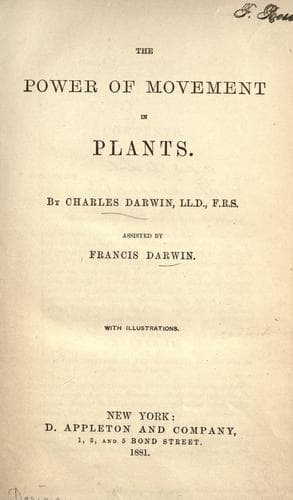
Botany; Geotropism; Plants -- Irritability and movements
Githago Caryophylleae (26). Stellaria (Batalin). ” Portulaca
(Ch.Royer). Portulaceae (27). Sida Malvaceae (36). Abutilon. ” Malva
(Linnæus and Pfeffer). ” Hibiscus (Linnæus). ” Anoda. ” Gossypium. ”
Ayenia (Linnæus). Sterculaceae (37). Triumfetta (Linnæus). Tiliaceae
(38). Linum (Batalin). Lineae (39). Oxalis. Oxalidæ (41). Averrhoa. ”
Porlieria. Zygophylleæ (45). Guiacum. ” Impatiens (Linnæus, Pfeffer,
Batalin). Balsamineae (48). Tropaeolum. Tropaeoleae (49). Crotolaria
(Thiselton Dyer). Leguminosae (75) Tribe II. Lupinus. ” ” Cytisus. ” ”
Trigonella. ” Tr. III. Medicago. ” Melilotus. ” ” Trifolium. ” ”
Securigera. ” Tr. IV. Lotus. ” ” Psoralea. ” Tr. V. Amorpha
(Cuchartre). ” ” Daelea. ” ” Indigofera. ” ” Tephrosia. ” ” Wistaria. ”
” Robinia. ” ” Sphaerophysa. ” ” Colutea. ” ” Astragalus. ” ”
Glycyrrhiza. ” ” Coronilla. ” Tr. VI. Hedysarum. ” ”
Genus Family. Onobrychis. Leguminosae (75) Tr. VI. Smithia. ” ”
Arachis. ” ” Desmodium. ” ” Urania. ” ” Vicia. ” Tr. VII. Centrosema. ”
Tr. VIII. Amphicarpæa. ” ” Glycine. ” ” Erythrina. ” ” Apios. ” ”
Phaseolus. ” ” Sophora. ” Tr. X. Caesalpinia. ” Tr. XIII. Haematoxylon.
” ” Gleditschia (Duchartre). ” ” Poinciana. ” ” Cassia. ” Tr. XIV.
Bauhinia. ” Tr. XV. Tamarindus. ” Tr. XVI. Adenanthera. ” Tr. XX.
Prosopis. ” ” Neptunia. ” ” Mimosa. ” ” Schrankia. ” ” Acacia. ” Tr.
XXII. Albizzia. ” Tr. XXIII. Melaleuca (Bouché). Myrtaceae (94). Genus
Family. Aenothera (Linnæus). Omagrarieae (100). Passiflora.
Passifloracea (105). Siegesbeckia. Compositæ (122). Ipomœa.
Convolvulacea (151). Nicotiana. Solaneae (157). Mirabilis. Nyctagineae
(177). Polygonum (Batalin). Polygoneae (179). Amaranthus. Amaranthaceae
(180). Chenopodium. Chenopodieae (181). Pimelia (Bouché). Thymeteae
(188). Euphorbia. Euphorbiaceae (202) Phyllanthus (Pfeffer). ”
Sub-class II. GYMNOSPERMS. Aies (Chatin).
CLASS II. MONOCOTYLEDONS.
Thalia. Cannaceae (21). Maranta. ” Colocasia. Aroideae (30). Strephium.
Gramineæ (55).
CLASS III. ACOTYLEDONS.
Marsilea. Marsileaceae (4).
Githago segetum (Caryophylleae).—The first leaves produced by young
seedlings, rise up and close together at night. On a rather older
seedling, two young leaves stood at noon at 55° above the horizon, and
at night at 86°, so each had risen 31°. The angle, however, was less in
some cases. Similar observations were occasionally made on young leaves
(for the older ones moved very little) produced by nearly full-grown
plants. Batalin says (‘Flora,’ Oct. 1st, 1873, p. 437) that the young
leaves of Stellaria close up so completely at night that they form
together great buds.
Public-domain text, read in full here on John Shaqi.
Reviews
Reviews
No reviews yet
Be the first to share your thoughts on this work.
Elsewhere in the archive
Join the Discussion
Join the discussion
Sign in to leave a comment or review.
Sign InorCreate an account