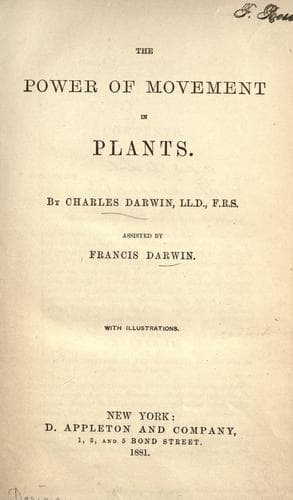
Botany; Geotropism; Plants -- Irritability and movements
From the several cases now given, which refer to widely distinct
plants, we may infer that there is some close connection between the
reduced size of one or both cotyledons and the formation, by the
enlargement of the hypocotyl or of the radicle, of a so-called bulb.
But it may be asked, did the cotyledons first tend to abort, or did a
bulb first begin to be formed? As all dicotyledons naturally produce
two well-developed cotyledons, whilst the thickness of the hypocotyl
and of the radicle differs much in different plants, it seems probable
that these latter organs first became from
some cause thickened—in several instances apparently in correlation
with the fleshy nature of the mature plant—so as to contain a store of
nutriment sufficient for the seedling, and then that one or both
cotyledons, from being superfluous, decreased in size. It is not
surprising that one cotyledon alone should sometimes have been thus
affected, for with certain plants, for instance the cabbage, the
cotyledons are at first of unequal size, owing apparently to the manner
in which they are packed within the seed. It does not, however, follow
from the above connection, that whenever a bulb is formed at an early
age, one or both cotyledons will necessarily become superfluous, and
consequently more or less rudimentary. Finally, these cases offer a
good illustration of the principle of compensation or balancement of
growth, or, as Goethe expresses it, “in order to spend on one side,
Nature is forced to economise on the other side.”
Circumnutation and other movements of Hypocotyls and Epicotyls, whilst
still arched and buried beneath the ground, and whilst breaking through
it.—According to the position in which a seed may chance to have been
buried, the arched hypocotyl or epicotyl will begin to protrude in a
horizontal, a more or less inclined, or in a vertical plane. Except
when already standing vertically upwards, both legs of the arch are
acted on from the earliest period by apogeotropism. Consequently they
both bend upwards until the arch becomes vertical. During the whole of
this process, even before the arch has broken through the ground, it is
continually trying to circumnutate to a slight extent; as it likewise
does if it happens at first to stand vertically up,—all which cases
have been observed and described, more or less fully, in the last
chapter. After the arch has grown to some
height upwards the basal part ceases to circumnutate, whilst the upper
part continues to do so.
Public-domain text, read in full here on John Shaqi.
Reviews
Reviews
No reviews yet
Be the first to share your thoughts on this work.
Elsewhere in the archive
Join the Discussion
Join the discussion
Sign in to leave a comment or review.
Sign InorCreate an account