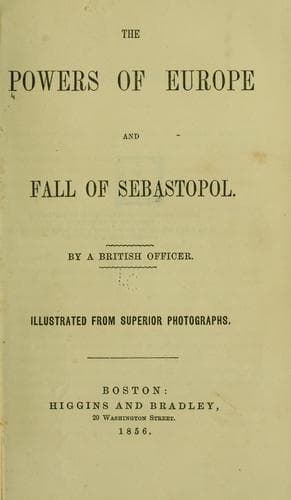
The Powers of Europe and Fall of Sebastopol — John Shaqi
The Powers of Europe and Fall of SebastopolA British officer
History
The Powers of Europe and Fall of Sebastopol
A British officer
Crimean War, 1853-1856; Europe -- History -- 1789-1900
Such was the state of the principal European powers at the
commencement of the war. The celebrated 10th of August, 1792, came,
and the throne was overturned, the royal family put in captivity,
while the massacres of September drenched Paris with blood. The
victories of Dumourier rolled back the tide of foreign invasion to
the Rhine. War was declared against Sardinia, 15th September, and
Savoy and Nice were seized and united to the French Republic.
“The die is thrown, we have rushed into the career; all governments
are our enemies, all people are our friends; we must be destroyed or
they shall be free,” exclaimed the orator of the convention. Geneva
surrendered to the French without a blow, and the Convention declared
it would grant its assistance to all people who wished to recover
their liberty. Flanders was overrun by the French in a fortnight, and
they committed an aggression on the Dutch by opening the Scheldt, and
by pursuing the fugitive Austrians into Dutch territory.
While the tide of Austrian and Prussian invasion was rolled back
to the Rhine, the great frontier city of Germany was wrested from
Austria almost under the eyes of the imperial armies; and although
the campaign commenced only in August, under the greatest apparent
disadvantage to the French, yet before the close of December all this
had been accomplished. The execution of Louis XVI. on the 21st Jan.,
1793, completed the destruction of the French monarchy, accelerated
the Reign of Terror, and brought the accession of England to the
league of the _Allied Sovereigns_; Chauvelin, the French Ambassador,
received orders immediately to quit London; and this was succeeded
in a few days by a declaration of war, 1st February, 1793, by France
against England, Spain, and Holland. The audacity of the Convention,
which thus threw down the gauntlet to nearly all of Europe, excited
universal astonishment. The feeling of national honor, in all ages so
powerful among the French, was awakened to its highest pitch. Every
species of requisition was cheerfully furnished under the pressure
of impending calamity; and in the dread of foreign subjugation the
loss of fortune and employment was forgotten only one path, that
of honor, was open to the brave. The Jacobins, the ruling power in
France, were no longer despised but feared by the European powers,
and terror prompts more vigorous efforts than contempt. No sooner
did the news of the execution of Louis reach St. Petersburg than the
Empress Catharine took the most decisive measures, and all Frenchmen
who did not renounce the principles of the revolution were ordered
to quit her territory; the most intimate relations were established
between the courts of London and St. Petersburg; and a treaty between
them, which laid the basis of the Grand Alliance, was signed, 25th
March, in which they engaged to carry on the war against France, and
not to lay down their arms without restitution of all the conquests
Public-domain text, read in full here on John Shaqi.
Reviews
Reviews
No reviews yet
Be the first to share your thoughts on this work.
Join the Discussion
Join the discussion
Sign in to leave a comment or review.
Sign InorCreate an account