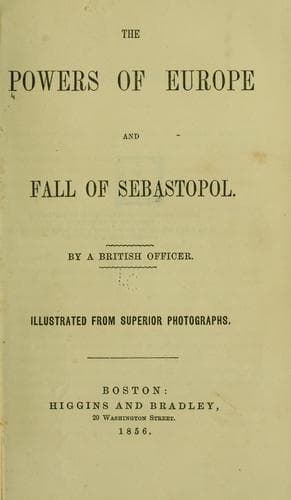
The Powers of Europe and Fall of SebastopolA British officer
History
The Powers of Europe and Fall of Sebastopol
A British officer
Crimean War, 1853-1856; Europe -- History -- 1789-1900
No incident of particular interest occurred in our route, and we
found ourselves on the 3d of June in safety in Brussels, where we
remained in garrison until that great battle which decided the fate
of Europe, and sent the French Emperor to his lonely home on the
barren rock of St. Helena.
CHAPTER VI.
Brief Summary of Events for Four Years preceding the Battle of
Waterloo--Author’s Narrative resumed at that Period--Preparation
of Troops for the Battle--Skirmishing preceding its Commencement
--Reception of the News at Brussels--Departure of the English for
the Field of Battle--Disposition of the Forces--Attack upon
Hougomont--Progress of the Battle--Arrival of the Prussian
Reinforcements--Charge of the Old Guard--Flight of the French.
These four years thus spent to me were days of quiet, unmarked by
aught that would interest my readers; but four years more eventful,
more fraught with heavy consequences of good or ill to Europe, have
seldom--perhaps never--been numbered in her eventful history. The
victorious banners of France were waving on every battle-field on the
continent. Wagram and Jena, Austerlitz and Friedland, echoed back
the glory of the conqueror’s name; and kings and emperors, in whose
veins flowed the blood of the Cæsars, had esteemed it an honor to
claim alliance with the plebeian child of Corsica. But the Russian
bear and the English lion had not yet yielded to his claims; and,
gathering his vast and victorious armies, he led them to face a
sterner enemy and a more subtle foe than they had ever yet contested.
Half a million of men, firm and confident in their own resources,
had crossed the Niemen under Bonaparte’s approving eye. A few months
later, and the remnant of that scattered army, in rags, wan and
ghastly, staggered, like a band of spectres, over that same river.
No human might had struck them down; but the ice of winter and the
deep snows of the north, which the fur-clad Russian glories in, had
been the signal of death to the light-hearted child of vine-clad
France. He who had left France at the head of such glorious armies
had returned to his capital alone with his own brave heart and iron
courage, to find there that the arms and gold of the allies had done
their work.
Public-domain text, read in full here on John Shaqi.
Reviews
Reviews
No reviews yet
Be the first to share your thoughts on this work.
Elsewhere in the archive
Join the Discussion
Join the discussion
Sign in to leave a comment or review.
Sign InorCreate an account