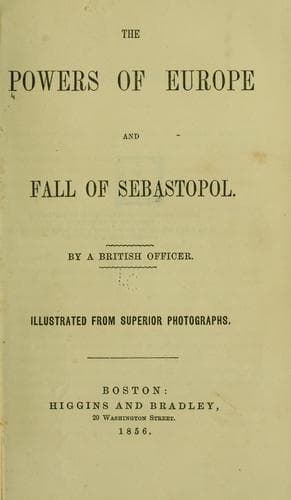
The Powers of Europe and Fall of SebastopolA British officer
History
The Powers of Europe and Fall of Sebastopol
A British officer
Crimean War, 1853-1856; Europe -- History -- 1789-1900
From Spain, the French had retreated step by step. Ferdinand,
soiled, even in his youth, with flagrant crimes, had returned amid
rejoicings and banquets to his capital, to sink still deeper in
shame and contempt the Bourbon name, and to reward with dungeons
and tears and blood the brave hearts that had struggled so long and
nobly for his kingdom. Joseph had fled before him on foot, scarcely
escaping with his life from that kingdom, which might, indeed, have
taken a glorious place among the nations, had he had the courage or
ability to carry out, in the spirit that dictated them, the great
and far-seeing plans of his brother. On every side the nations
turned their arms against the falling emperor, until, at length, he
who had disposed in his palace of the thrones of Europe had only
left one small island, which must have seemed to him but a child’s
bauble, in view of the past. He _would_ not rest here, and the
events of the hundred days had roused again the world to arms. The
prestige of his name had won back the allegiance of the French, and
thousands had, as in days of yore, collected around his standard. The
battle which should decide the fate of Europe drew on. France stood
alone, on the one side, with her veteran troops, and her memories
of glorious victories, and, more than all, her emperor; and on the
other were the united forces of England and the continent. Napoleon
was confident of victory. On the 14th of June, in his own resistless
eloquence, he thus addressed his army, the last he was ever destined
to command:--“Soldiers, this day is the anniversary of Marengo and
Friedland, which twice decided the destiny of Europe. Then, as after
the battle of Austerlitz, as after the battle of Wagram, we were too
generous. We believed in the oaths and protestations of princes, whom
we left on their thrones. Now, however, leagued together, they aim
at the independence and the most sacred rights of France. They have
committed the most unjust aggressions. Let us, then, march and meet
them. Are not we and they still the same men? Soldiers, at Jena,
against these same Prussians, now so arrogant, you were one to three;
and at Montmirail, one to six. Let those among you who have been
captives to the English describe the nature of their prison-ships,
and the horrible sufferings they endured. The Saxons, the Belgians,
the Hanoverians, the soldiers of the Confederation of the Rhine,
lament that they are obliged to use their arms in the cause of
princes who are the enemies of justice and the rights of all
nations. They know that this coalition is insatiable. After having
devoured twelve millions of Poles, twelve millions of Italians, one
million of Saxons, and six millions of Belgians, it now wishes to
devour the states of the second rank in Germany.
Public-domain text, read in full here on John Shaqi.
Reviews
Reviews
No reviews yet
Be the first to share your thoughts on this work.
Elsewhere in the archive
Join the Discussion
Join the discussion
Sign in to leave a comment or review.
Sign InorCreate an account