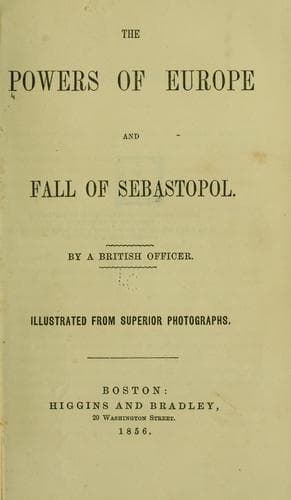
The Powers of Europe and Fall of SebastopolA British officer
History
The Powers of Europe and Fall of Sebastopol
A British officer
Crimean War, 1853-1856; Europe -- History -- 1789-1900
“Did you not hear it? No! ’twas but the wind,
Or the car rattling o’er the stony street;
On with the dance! let joy be unconfined!
No sleep till morn, when youth and pleasure meet,
To chase the glowing hours with flying feet!
But hark! that heavy sound breaks in once more,--
As if the clouds its echo would repeat,--
And nearer, clearer, deadlier than before.
Arm! arm! it is, it is the cannon’s opening roar!
“Ah! then, and there was hurrying to and fro,
And gathering tears, and tremblings of distress,
And cheeks all pale, which, but an hour ago,
Blushed at the praise of their own loveliness.
And there were sudden partings, such as press
The life from out young hearts, and choking sighs,
Which ne’er might be repeated;--who could guess
If evermore should meet those mutual eyes,
Since upon night so sweet such awful morn could rise!”
By two o’clock the Duke of Wellington had left Brussels, and
before light he reached Bry, at which place Blucher was stopping,
and there the plan of the day was agreed upon. Napoleon resolved,
with his own troops, to attack the Prussian army, because that had
concentrated all its strength, while forty-five thousand men, under
Ney, were to give battle to the English. At early dawn, on the
16th, hostilities were renewed. The morning, however, was occupied
in slight skirmishes, in which the soldiers in both armies showed
their bravery. The main contest between the English and the French
commenced about three in the afternoon. The French were drawn up
among growing corn, so high as nearly to conceal them from sight. The
seventy-ninth and forty-second regiments were thus taken by surprise,
and nearly destroyed. Out of eight hundred men, but ninety-six
privates and four officers escaped. At night the English general
had possession of Quatre Bras. The number of killed and wounded on
the side of the allies was five thousand. Blucher fought as stern
a battle, but with less success. He had eighty thousand men, while
Napoleon was opposed to him with ninety thousand. The French and
Prussians felt for each other a mortal hatred, and little quarter was
either asked or given. When the night of the 16th closed around them,
thirty-five thousand men were left on the field of battle,--twenty
thousand of the Prussians, and fifteen thousand French. Blucher had
been forced to retire in the direction of Wavre, and so skilfully
were his movements made that it was noon on the 17th before Napoleon
discovered his retreat. As soon as Wellington learned that Blucher
had retreated, he gave orders to fall back from Quatre Bras to the
field of Waterloo. A heavy rain had fallen all day, and made the
roads almost impassable with mud. The English soldiers were wearied
with their day’s labor, and discouraged by the command to retreat;
but their spirits revived when, on reaching their bivouac for the
Public-domain text, read in full here on John Shaqi.
Reviews
Reviews
No reviews yet
Be the first to share your thoughts on this work.
Elsewhere in the archive
Join the Discussion
Join the discussion
Sign in to leave a comment or review.
Sign InorCreate an account