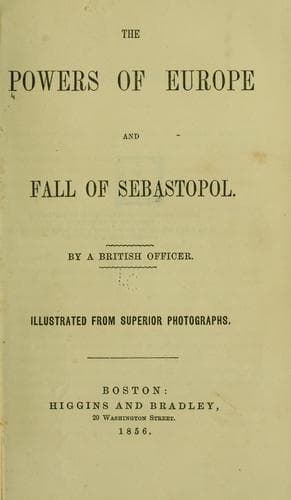
The Powers of Europe and Fall of SebastopolA British officer
History
The Powers of Europe and Fall of Sebastopol
A British officer
Crimean War, 1853-1856; Europe -- History -- 1789-1900
Grouchy, if report may be believed, corrupted by British gold,
remained in inglorious safety in his camp. He himself always
maintained that he believed the small detachment of the Prussian
army which remained near him was the whole of their force; and that,
though the very ground under him was shaken by the reverberation of
the continued discharges of artillery, he was acting up to his orders
in remaining to check the Prussians. Be this as it may, his conduct
decided the fate of the day.[2] “The destiny of Europe hung on the
feeble intellect of a single man; and his sluggish arm, in its tardy
movements, swept crowns and thrones before it, overturned one of the
mightiest spirits the world ever nurtured, and set back the day of
Europe’s final emancipation half a century. In a moment, Napoleon
saw that he could not sustain the attack of so many fresh troops,
if once allowed to form a junction with the allied forces; and so he
determined to stake his fate on one bold cast, and endeavor to pierce
the allied centre, with a grand charge of the Old Guard, and thus,
throwing himself between the two armies, fight them separately. For
this purpose, the Imperial Guard was called up, which had remained
inactive during the whole day, and divided into two immense columns,
which were to meet at the British centre. That under Reille no
sooner entered the fire than it disappeared like mist. The other
was placed under Ney,--the bravest of the brave,--and the order to
advance given. Napoleon accompanied them part way down the slope,
and, halting for a moment in a hollow, addressed them in his furious,
impetuous manner. He told them that the battle rested with them, and
he relied on their valor. ‘Vive l’Empereur!’ answered him, with a
shout that was heard all over the field of battle.
“The whole continental struggle exhibited no sublimer spectacle than
this last effort of Napoleon to save his sinking empire. Europe had
been put upon the plains of Waterloo to be battled for. The greatest
military energy and skill the world possessed had been tasked to the
utmost during the day. Thrones were tottering on the ensanguined
field, and the shadows of fugitive kings flitted through the smoke of
battle. Bonaparte’s star trembled in the zenith,--now blazing out in
its ancient splendor,--now suddenly paling before his anxious eye.
At length, when the Prussians appeared on the field, he resolved to
stake Europe on one bold throw. He saw his empire rest on a single
charge. The intense anxiety with which he watched the advance of
that column, and the terrible suspense he suffered when the smoke
of battle wrapped it from his sight, and the utter despair of his
great heart when the curtain lifted over a fugitive army, and the
despairing shriek rung on every side, ‘La garde recule,--la garde
recule,’ make us for a single moment forget all the carnage, in
sympathy with his distress.
Public-domain text, read in full here on John Shaqi.
Reviews
Reviews
No reviews yet
Be the first to share your thoughts on this work.
Elsewhere in the archive
Join the Discussion
Join the discussion
Sign in to leave a comment or review.
Sign InorCreate an account