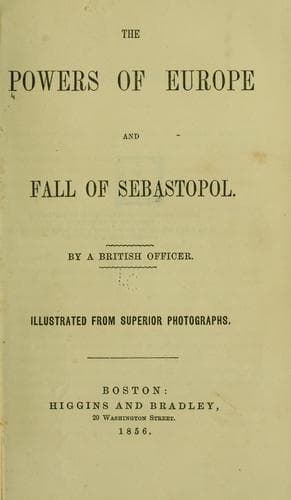
The Powers of Europe and Fall of SebastopolA British officer
History
The Powers of Europe and Fall of Sebastopol
A British officer
Crimean War, 1853-1856; Europe -- History -- 1789-1900
“Nothing could be more imposing than the movement of that grand
column to the assault. That guard had never yet recoiled before
a human foe, and the allied forces beheld with awe its firm and
terrible advance to the final charge. For a moment the batteries
stopped playing, and the firing ceased along the British lines,
as, without the beating of a drum or the blast of a bugle to cheer
their steady courage, they moved in dead silence over the plain.
The next moment the artillery opened, and the head of that gallant
column seemed to sink into the earth. Rank after rank went down, yet
they neither stopped nor faltered. Dissolving squadrons and whole
battalions disappearing, one after another, in the destructive fire,
affected not their steady courage. The ranks closed up as before,
and each treading over his fallen comrade, pressed firmly on. The
horse which the gallant Ney rode fell under him; and he had scarcely
mounted another, before it also sunk to the earth. Again and again
did that unflinching man feel his steed sink down, until five had
been shot under him. Then, with his uniform riddled with bullets,
and his face singed and blackened with powder, he marched on foot,
with drawn sabre in hand, at the head of his men. In vain did the
artillery hurl its storm of fire and lead into that living mass. Up
to the very muzzles they pressed, and, driving the artillery-men
from their own pieces, pushed on through the English lines. But, at
that moment, a file of soldiers, who had lain flat upon the ground
behind a low ridge of earth, suddenly arose and poured a volley in
their very faces. Another and another followed, till one broad sheet
of flame rolled on their bosoms, and in such a fierce and unexpected
flow that human courage could not withstand it. They reeled, shook,
staggered back, then turned and fled. Ney was borne back in the
refluent tide, and hurried over the field. But for the crowd of
fugitives that forced him on, he would have stood alone, and fallen
on his footsteps. As it was, disdaining to give way, though the whole
army was flying, that noble marshal formed his men into two immense
squares, and endeavored to stem the terrific current; and would have
done so, had it not been for the thirty thousand fresh Prussians that
pressed upon his exhausted ranks. For a long time, those squares,
under the unflinching Ney, stood, and let the artillery plough
through them. But the fate of Napoleon was writ, and though Ney
doubtless did what no other man in the army could have done, the
decree could not be reversed. The star that blazed so brightly over
the world went down with honor and in blood, and the ‘bravest of the
brave’ had fought his last battle. It was worthy of his great name;
and the charge of the Old Guard at Waterloo, with him at their head,
will be pointed to by remotest generations with a shudder.”
Public-domain text, read in full here on John Shaqi.
Reviews
Reviews
No reviews yet
Be the first to share your thoughts on this work.
Elsewhere in the archive
Join the Discussion
Join the discussion
Sign in to leave a comment or review.
Sign InorCreate an account