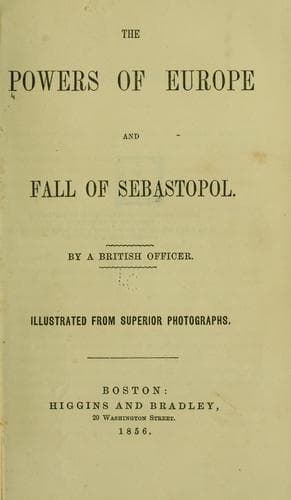
The Powers of Europe and Fall of SebastopolA British officer
History
The Powers of Europe and Fall of Sebastopol
A British officer
Crimean War, 1853-1856; Europe -- History -- 1789-1900
In the former half of the sixth century, Justinian was Emperor of
the East. His empire nearly corresponded in geographical extent with
the country which we now call Turkey in Europe. During his reign,
Constantinople was visited by a company of warlike strangers, whose
savage aspect filled all the people with amazement and fear. Their
long hair, which hung in tresses down their backs, was gracefully
bound with ribbons, but in the rest of their habit they resembled the
Huns. These were the first Turks ever seen in Europe. They had come
to offer the Emperor their alliance, which was accepted at a given
price. They had travelled from the foot of Mount Caucasus, where they
first heard of the splendor and weakness of the Roman Empire. Their
origin was beyond that celebrated ridge, and in the midst of another
no less celebrated, and which is variously known as the Caf, the
Imaus, the Golden Mountains, and the Girdle of the Earth. Here lived
the people called Geougen, governed by a great Khan. In the hills
they inhabited were many minerals. Iron and other mines were worked
for them by the most despised portion of their slaves, who were known
by the name of Turks. These slaves, under Bertezena, one of their
number, rebelled against the great Khan, and succeeded in possessing
themselves of their native country. From freedom they proceeded to
conquest, and it was in the course of their victories that they found
their way to the Caucasus. Nearly a century elapsed, and Heraclius
was Emperor. He formed an alliance with the Turks, and so honored
their prince as to place the imperial diadem on his head, and salute
him with a tender embrace as his son. In the ninth century the Turks
were introduced into Arabia. The Caliph Motassem employed them as his
own guards in his own capital. He educated them in the exercise of
arms, and in the profession of the Mahometan faith. No less a number
than 50,000 of these hardy foreigners did he thus foolishly establish
in the very heart of his dominions. In due time they became masters
of some portions of the country into which they had been admitted
as mercenaries. For one of their princes, Mahmood or Mahmud, the
title of Sultan was invented, about a thousand years after Christ.
Its meaning is autocrat or lord. His conquests were very extensive,
and stretched from Transoxiana to Ispahan--from the shores of the
Caspian to the mouth of the Indus.
Public-domain text, read in full here on John Shaqi.
Reviews
Reviews
No reviews yet
Be the first to share your thoughts on this work.
Elsewhere in the archive
Join the Discussion
Join the discussion
Sign in to leave a comment or review.
Sign InorCreate an account