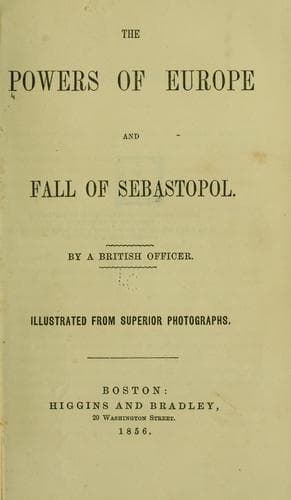
The Powers of Europe and Fall of SebastopolA British officer
History
The Powers of Europe and Fall of Sebastopol
A British officer
Crimean War, 1853-1856; Europe -- History -- 1789-1900
Toward the close of the twelfth century, Zingis (or Genghis) Khan
organized incredible hordes of Moguls and Tartars, and conquered
nearly all Asia west of India. After his death, the Tartar Empire was
broken up into fragments. Most of these resultant little kingdoms
gradually embraced Mahometanism, and amongst them was laid the
foundation of what is now called the Ottoman (or Turkish) Empire.
Incited by the example and success of the terrible Tartar, Shah
Soliman, prince of the town of Nera, on the Caspian Sea, spread the
terror of his arms all through Asia Minor, as far as the Euphrates.
He was drowned in the passage of that river. His son, Orthogrul,
succeeded him. This chief was the father of Thaman, or Athman, whose
Turkish name has been melted into the appellation of the Caliph
Othman. He was an aspiring and clever man, and soon freed himself
from the control of a superior, as the power of the Mogul Khans had
become well nigh extinct. He resolved to propagate the religion of
the Koran by every means in his power; and began his holy war against
the infidels by making a descent into Nicomedia. This he did in
July, 1299. He was entirely victorious; and for twenty-seven years
he repeated similar inroads, and achieved similar conquests in other
directions. Towards the close of his reign, Prusa (Boursa), the
capital of Bithynia, surrendered to his son Orchan, who, after his
father’s death, made it the seat of his government. This was in the
year 1326, and from that time we may date the true era of the Ottoman
Empire,--the name of which is plainly derived from that of the
Caliph Othman. His power rapidly increased. Many cities and districts
fell into his hands,--amongst others, Ephesus, and the other six
places, in which were the seven churches of Asia. Christianity in all
these localities, except Philadelphia, was speedily extinguished, and
supplanted by Islamism. Orchan had two sons, Soliman and Amurath.
The former subdued Thrace, and possessed himself of Gallipoli, and
was at last killed by a fall from his horse. The aged Emir (for
no higher title had Orchan assumed) wept, and expired on the tomb
of his valiant son. Amurath stept into his place, and wielded the
scimitar with all his father’s energy. By the advice of his vizier,
he selected for his own use the fifth part of the Christian youth in
the provinces which he subjugated. His choice fell on the stoutest
and most beautiful. These were named “yengi cheri,” or new soldiers.
In more recent times the haughty troops, originated in this way, have
gone by the name of Janissaries. At first they were courageous and
zealous in the cause of their new master and new religion. For a long
while they were the _élite_ of the Turkish forces, and in critical
outbreaks have often been a source of great anxiety to the sultans
themselves.
Public-domain text, read in full here on John Shaqi.
Reviews
Reviews
No reviews yet
Be the first to share your thoughts on this work.
Elsewhere in the archive
Join the Discussion
Join the discussion
Sign in to leave a comment or review.
Sign InorCreate an account