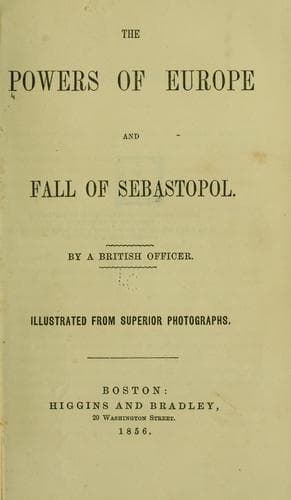
The Powers of Europe and Fall of SebastopolA British officer
History
The Powers of Europe and Fall of Sebastopol
A British officer
Crimean War, 1853-1856; Europe -- History -- 1789-1900
Bajazet, his son and successor, surnamed “Ilderim,” or Lightning, was
a man of fiery and energetic temperament. His territory was rapidly
extended over the whole country, from Boursa to Adrianople, from the
Danube to the Euphrates. He turned his arms against Hungary; and at
Nicopolis defeated 100,000 Christians, who had proudly boasted that
if the sky should fall they could uphold it on their lances. Bajazet
boasted that he would advance to Germany and Italy, and feed his
horse with a bushel of oats on the altar of St. Peter’s at Rome. A
fit of the gout prevented his fulfilment of this threat. Meanwhile
there rose up another great Mogul conqueror, Timour, or Tamerlane,
who avenged the defeat of his ancestors upon the Turks. Bajazet (who
had assumed the title of sultan) was conquered and taken captive.
From the Irtysh and Volga to the Persian Gulf, and from the Ganges
to Damascus and the Archipelago, Asia was in the hands of Timour;
his armies were invincible, his ambition was boundless, and his zeal
might have aspired to conquer and convert the Christian kingdoms of
the West, which already trembled at his name. But he was not master
of a single galley, with which to cross the Bosphorus or Dardanelles.
This insuperable obstacle checked his career. At length he died,
and the Ottoman power, like a strong tree recovering itself after a
storm, began again to stand erect and flourish.
The great-grandson of Bajazet was Mahomet II. He emulated the Grecian
Alexander. He laid siege to Constantinople, investing it with an army
of 258,000 Turks. His navy comprised about 320 vessels, of which 18
were galleys of war. He had engaged the services of a Danish, or
Hungarian, founder of cannon, who made him a field-piece capable of
throwing a ball, which weighed 600 pounds, more than a mile. This
could be fired only seven times in one day. Never before had the
recent invention of gunpowder been employed with such terrible effect
as at this siege of Constantinople. The inhabitants of that city
were more than 100,000, but of those not more than 4,970, together
with a body of 2,000 strangers, were capable of bearing arms. How
small a garrison to defend a city of thirteen, or perhaps sixteen,
miles in extent! Yet, under these doleful circumstances, the city was
distracted with religious discord, just as Jerusalem was before and
during its siege by Titus. An immense chain closed the mouth of the
harbor, whilst the mouth of the Bosphorus was defended by a fleet
which was superior to that of the Turks. The city seemed incapable
of being reduced. The Turks despaired: the Christians triumphed. In
this perplexity it occurred to Mahomet to transport his fleet across
the land. By amazing ingenuity and toil, he accomplished this feat.
The distance was ten miles, yet in a single night he thus launched
eighty of his light vessels into the harbor. The success of this
scheme was perfect. He found his way into the city, which was taken
May 29th, 1453.
Public-domain text, read in full here on John Shaqi.
Reviews
Reviews
No reviews yet
Be the first to share your thoughts on this work.
Elsewhere in the archive
Join the Discussion
Join the discussion
Sign in to leave a comment or review.
Sign InorCreate an account