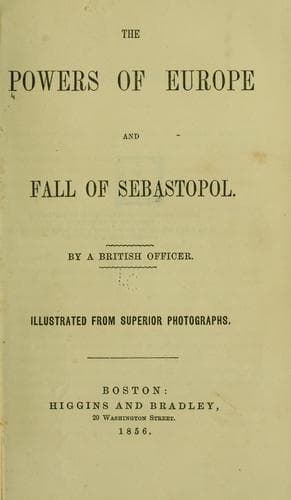
The Powers of Europe and Fall of SebastopolA British officer
History
The Powers of Europe and Fall of Sebastopol
A British officer
Crimean War, 1853-1856; Europe -- History -- 1789-1900
Although the first Russian empire, which was governed by Rurik, was
founded by Normans (the Varangians), who must have introduced into
Russia the fundamental Germanic institutions and the principles of
the feudal system, this system never took root amongst the Sclavonian
population. On the contrary, all the popular institutions of Russia
assumed the patriarchal character, which is peculiarly adapted to
the Sclavonian race, and especially to the Russian people, which in
this respect _closely resembles the ancient nations of the East_.
The social organization of Russia forms in all its relations and
degrees an uninterrupted scale of hierarchy, every step of which
rests on some patriarchal power. The father is the absolute sovereign
of the family, which cannot exist without him. If the father dies,
the eldest son takes his place and exercises the full paternal
authority. The property of the family is common to all the males
belonging to it, but the father or his representative can alone
dispose of it. Next comes the village or township, which is like
an enlarged family, governed by an elected father or starost. This
starost is elected for three years. His power is absolute, and he is
obeyed without restriction. All the inhabited and cultivated lands
of the village are held in common as undivided property. No portion
is ceded as private property. The starost divides the fruits or
profits of the whole amongst them. So, again, all these villages or
townships form the nation; a nation of men equal among themselves,
and equally subject to the chief of the empire and the race--the
Czar. The authority of the Czar is absolute, like the obedience of
his subjects. Any restriction on the authority of the Czar appears
to a true Russian as a monstrous contradiction. “Who can limit the
power or the rights of a father?” says the Russian; “he holds them,
not from us, who are his children, nor from any man, but from God,
to whom he will one day answer for them.” The mere form of words,
“It is ordered,” has a magical effect on the Russians. They pay the
same respect to the agents of the government, whom they regard as the
servants of the Czar, and to all their superiors. A Russian calls
_batiouschka_--_little papa_--not only his father or an old man, but
the starost, or any of his superiors. The Emperor himself is never
addressed by the people by any other name. An old serf will call his
master “little papa,” even though he should be a child of ten years
old.
Public-domain text, read in full here on John Shaqi.
Reviews
Reviews
No reviews yet
Be the first to share your thoughts on this work.
Elsewhere in the archive
Join the Discussion
Join the discussion
Sign in to leave a comment or review.
Sign InorCreate an account