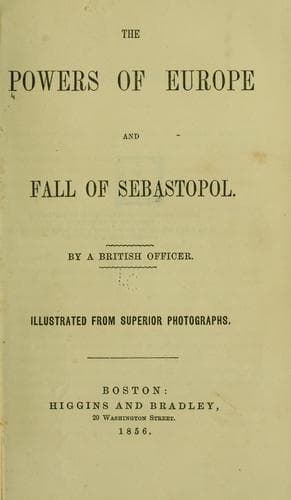
The Powers of Europe and Fall of SebastopolA British officer
History
The Powers of Europe and Fall of Sebastopol
A British officer
Crimean War, 1853-1856; Europe -- History -- 1789-1900
In Russia there is no national or domestic association which has not
its centre, its unity, its chief, its father, its master. A chief is
absolutely indispensable to the existence of Russians. They choose
another father when they lose their own. The starost is elected to
be unconditionally obeyed. This must be well understood in order to
comprehend the true position of the Czar. The Russian nation is like
a hive of bees, which absolutely require a queen-bee. In Russia the
Czar is not the delegate of the people, nor the first servant of the
state, nor the legal owner of the soil, nor even a sovereign by the
grace of God. He is at once the unity, the chief, and the father of
his people. He does not govern by right of office, but, as it were,
by the ties of blood, recognised by the whole nation. This feeling is
as natural to the whole population as that of their own existence,
insomuch that the Czar can never do wrong. Whatever happens, the
people always think him right. Any restriction on his power, even
to the extent of one of the German Diets, would be considered in
Russia an absurd chimera. The Czar Ivan IV. committed the most cruel
actions, but the people remained faithful to him, and loved him all
the more. To this day he is the hero of the popular ballads and
legends of the country. When the Czar Ivan the Terrible, weary of
governing, sought to abdicate, the Russians flung themselves at his
feet to entreat him to remain on the throne.
The feeling of the Russians is not so much one of deep attachment to
their country as of ardent patriotism. Their country, the country of
their ancestors, the Holy Russia, the people fraternally united under
the sceptre of the Czar, the communion of faith, the ancient and
sacred monuments of the realm, the tombs of their forefathers--all
form a whole which excites and enraptures the mind of the Russians.
They consider their country as a sort of kinsmanship to which they
address the terms of familiar endearment. God, the Czar, and the
priest, are all called “Father,”--the Church is their “Mother,” and
the empire is always called “Holy Mother Russia.” The capital of the
empire is “Holy Mother Moscow,” and the Volga “Mother Volga.” Even
the high road from Moscow to Vladimir is called “our dear mother the
high road to Vladimir.” But above all, Moscow, the holy mother of the
land, is the centre of Russian history and tradition, to which all
the inhabitants of the empire devote their love and veneration. Every
Russian entertains all his life long the desire to visit one day the
great city, to see the towers of its holy churches, and to pray on
the tombs of the patron saints of Russia. “Mother Moscow” has already
suffered and given her blood for Russia, as all the Russian people
are ready to do for her.
Public-domain text, read in full here on John Shaqi.
Reviews
Reviews
No reviews yet
Be the first to share your thoughts on this work.
Elsewhere in the archive
Join the Discussion
Join the discussion
Sign in to leave a comment or review.
Sign InorCreate an account