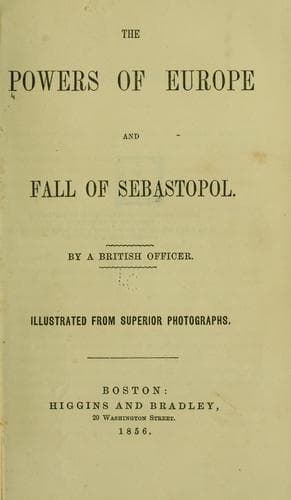
The Powers of Europe and Fall of Sebastopol — John Shaqi
The Powers of Europe and Fall of SebastopolA British officer
History
The Powers of Europe and Fall of Sebastopol
A British officer
Crimean War, 1853-1856; Europe -- History -- 1789-1900
On one occasion, while the youths were playing the death of Cæsar
in their theatre, the wife of the porter, well known to the boys,
presented herself at the door, and being refused admittance made
some disturbance; the matter was referred to the young Napoleon,
who was the officer in command on the occasion. “Remove that woman
who brings here the license of camps!” said the future ruler of the
revolution. At the age of fourteen he was sent to the military school
at Paris, and at _sixteen_ he received a commission in a regiment of
artillery. When the revolution broke out he adhered to the popular
side. After the siege of Toulon, Dugommier, the general in command,
wrote to the Convention, “Reward and promote that young man, for if
you are ungrateful to him he will raise himself alone.” He commanded
the artillery in 1794 during the campaign in Italy. Dumbion, in
command of the army, who was old, submitted the direction of affairs
principally to Bonaparte. His intimacy with the younger Robespierre,
and his refusal of a command in La Vendée in the civil insurrection,
led to his being deprived of his rank as a general officer, and he
was reduced to private life. But his talents being known led to his
being called to the command of the forces in Paris, which triumphed
over the sections; his decision saved the Convention. The story of
his introduction to and marriage of Josephine is too well known to
need repetition.
In 1796 Bonaparte took command of the forces destined to operate
against Italy. With an army destitute of almost every thing, he, in
a short time, overran Piedmont, conquered a peace with Sardinia,
passed the Po and crossed the Adda at the Bridge of Lodi. The nervous
eloquence of Napoleon, in his address to his soldiers, and the
splendor of his success, intoxicated Paris with joy. The first day,
they heard that the gates of the Alps were opened; the next, that the
Austrians were separated from the Piedmontese army; the third that
the Piedmontese army was destroyed and the fortresses surrendered.
The rapidity of this success, the number of prisoners, exceeded
all that had yet been witnessed. Every one asked, who was this
young conqueror whose fame had burst forth so suddenly, and whose
proclamations breathed the spirit of ancient glory?
“The 13th of Vendemiaire and the victory of Montenotte,” said
Napoleon, “did not induce me to think myself a superior character. It
was after the passage of Lodi that the idea shot across my mind that
I might become a decisive actor on the political theatre; then arose
for the first time the spark of great ambition.”
Public-domain text, read in full here on John Shaqi.
Reviews
Reviews
No reviews yet
Be the first to share your thoughts on this work.
Join the Discussion
Join the discussion
Sign in to leave a comment or review.
Sign InorCreate an account