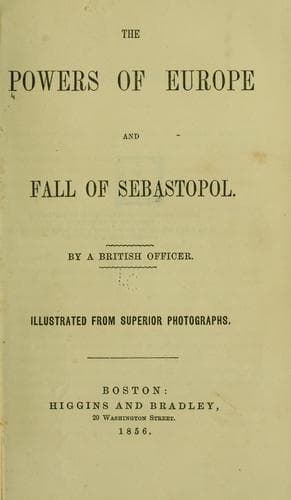
The Powers of Europe and Fall of SebastopolA British officer
History
The Powers of Europe and Fall of Sebastopol
A British officer
Crimean War, 1853-1856; Europe -- History -- 1789-1900
On the 2d March the Russian Prince, attired in the plainest
manner without a decoration of any kind, had an interview with
the Grand Vizier, and was by him referred to Fuad Effendi, the
Minister of Foreign Affairs. Fuad Effendi had, however, uniformly
distinguished himself by his determined opposition to the advances
of Russia: Prince Menschikoff, therefore, haughtily declined to
hold communication with him. As was expected, Fuad sent in his
resignation, and great was the consequent delight experienced at the
Russian embassy. Nor was that satisfaction altogether unfounded, for
Fuad Effendi was undoubtedly one of the ablest men in Turkey.
He was succeeded by Rifaat Pacha, a man of considerable talent, but
by no means competent to cope with the daring policy of the Czar.
Prince Menschikoff, indeed, now regarded the game as in his own
hands, for he was provided with an autograph letter from the Czar,
authorizing him to treat as a personal insult to Nicholas himself,
any hesitation on the part of the Sultan or his advisers to accept
the propositions submitted by him.
It is evident enough that Russia was at this time ill-informed as to
the feeling both of England and France on the subject of the “Eastern
question,” or she would hardly have ventured to commit herself so
far as she did in the demands addressed to Rifaat Pacha by Prince
Menschikoff, on the 19th April, 1853, of which the following is an
abstract:
“1. A definite firman securing to the Greek Church the custody of
the key of the Church of Bethlehem; of the silver star pertaining
to the altar of the Nativity; of the grotto of Gethsemane (with the
admission of the Latin priests thereto for the celebration of their
rites); the joint possession by the Greeks and the Latins of the
gardens of Bethlehem.
“2. An immediate order on the part of the government for the thorough
repair of the cupola of the temple of the Holy Sepulchre to the
satisfaction of the Greek Patriarch.
“3. A guarantee for the maintenance of the privileges of the Greek
Church in the East, and of those sanctuaries already in the exclusive
possession of that Church, or shared by it with others.”
The note containing these demands, and some others of minor
importance, was couched in rather menacing if not insolent language,
while the reply of the Porte was firm, temperate and dignified;
expressive of its readiness to do all that could be fairly demanded
of it, and concluding with a declaration of its inability to accede
to such violation of its independence and national rights as was
implied in the Russian note; appealing at the same time to the
emperor’s own sense of justice and honor.
Public-domain text, read in full here on John Shaqi.
Reviews
Reviews
No reviews yet
Be the first to share your thoughts on this work.
Elsewhere in the archive
Join the Discussion
Join the discussion
Sign in to leave a comment or review.
Sign InorCreate an account