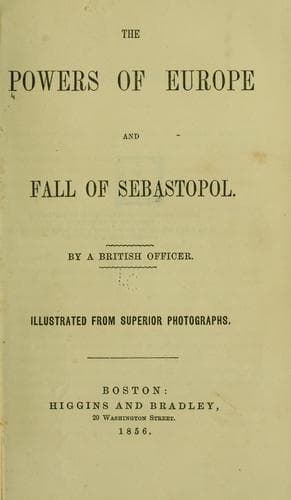
The Powers of Europe and Fall of SebastopolA British officer
History
The Powers of Europe and Fall of Sebastopol
A British officer
Crimean War, 1853-1856; Europe -- History -- 1789-1900
It would be quite superfluous to introduce here all the voluminous
correspondence that ensued between the two Powers. Suffice it to
observe, that whatever might have been the concessions on the side of
the Porte, they would evidently have been met by further and still
more exorbitant demands on the part of Russia, as the intention of
that Power, from the first, was evidently to bring matters to an
open rupture. Surely for no other purpose could the ruler of a vast
territory have been suddenly called upon, as he had been not long
before at five days’ notice, to divest himself of all authority over
many millions of his subjects, and to admit, in fact, of a partition
of his empire. What the precise designs of Russia were, are clearly
shown in the following extract of a letter from Prince Lieven to
Count Nesselrode:
“Our policy,” said he, “must be to maintain a reserved and prudent
attitude, until the moment arrives for Russia to vindicate her
rights, and for the rapid action which she will be obliged to adopt.
_The war ought to take Europe by surprise (!)_ Our movements must
be prompt, so that the other powers should find it impossible to be
prepared for THE BLOW THAT WE ARE ABOUT TO STRIKE.”
The Cabinets of London and Paris having received early intimation
of what was going on, and being well satisfied that the Greek
inhabitants of Turkey needed no additional protection, speedily
concerted measures for the defence of the Ottoman empire and of their
own interests. The political correspondence now became still more
involved and prolix; but as more than mere verbal assurances were
required to satisfy the Porte of the material support of the two
great Western Powers, the combined fleets were directed to anchor in
Besika Bay.
Public-domain text, read in full here on John Shaqi.
Reviews
Reviews
No reviews yet
Be the first to share your thoughts on this work.
Elsewhere in the archive
Join the Discussion
Join the discussion
Sign in to leave a comment or review.
Sign InorCreate an account