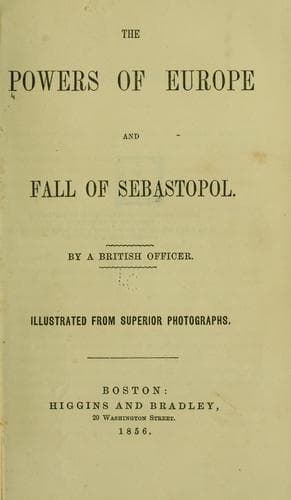
The Powers of Europe and Fall of SebastopolA British officer
History
The Powers of Europe and Fall of Sebastopol
A British officer
Crimean War, 1853-1856; Europe -- History -- 1789-1900
Late in 1853 came the tedious conference of Vienna, with its notes,
its projects of notes, its despatches, its _ultimatums_ and its
_ultimatissimums_. The result was, the consumption of a vast amount
of time, foolscap, post-horses, and government messengers, the
concession to Austria of much more importance and consideration than
she was in any way entitled to, and the retention at Besika, till the
end of November, of the allied fleets, which ought to have passed
through the Bosphorus more than four months before,--on the day,
indeed, that the Russians crossed the Pruth. The “occupation” which
ensued amounted, in fact, to the tyrannical assumption by Russia of
the government of two of the finest provinces in Europe, accompanied
by such atrocious acts of tyranny, that the English and French
consuls found it incumbent upon them at once to withdraw.
Some time after the conclusion of the treaty of Adrianople, in
1828, Count Nesselrode, writing to the Grand Duke Constantine, thus
gave expression to the feelings of the government of Russia on this
subject:--
“The Turkish monarchy,” said he, “is reduced to such a state as to
exist only under the protection of Russia, and must comply in future
with her wishes.” Then, adverting to the Principalities, he says,
“The possession of these Principalities is of the less importance
to us, as without maintaining troops there, which would be attended
with considerable expense, we shall dispose of them at our pleasure,
as well during peace as in time of war. _We shall hold the keys of a
position from which it will be easy to keep the Turkish government in
check_, and the Sultan will feel that any attempt to brave us again
must end in his certain ruin.”
Public-domain text, read in full here on John Shaqi.
Reviews
Reviews
No reviews yet
Be the first to share your thoughts on this work.
Elsewhere in the archive
Join the Discussion
Join the discussion
Sign in to leave a comment or review.
Sign InorCreate an account