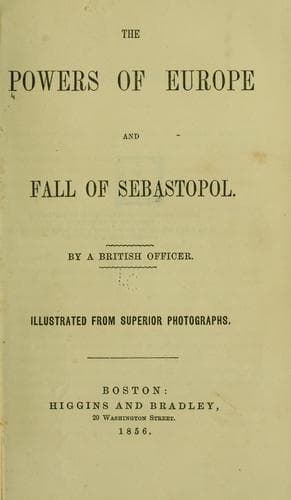
The Powers of Europe and Fall of SebastopolA British officer
History
The Powers of Europe and Fall of Sebastopol
A British officer
Crimean War, 1853-1856; Europe -- History -- 1789-1900
The protest of the Porte against the invasion of these provinces
bears date the 14th July: from that day till the end of September,
the conference at Vienna, urged chiefly by Austria, had been making
strenuous efforts to induce the Turkish government to yield to the
arrogant pretensions of Russia. No enviable position, indeed, was
that of the Sultan: beset on one side by the _friendly_ persuasions
of Francis Joseph, and on the other by the imperious summons of
Nicholas, who was actively intriguing in every direction, through
numberless astute emissaries, to give rise to a belief that the
presence of his troops in the Principalities was in conformity to the
wishes of the population themselves. On the 8th October, the Grand
Vizier (Mustapha Pacha) issued a proclamation to the inhabitants of
Constantinople, highly characteristic of the spirit of tolerance
which now animates the people of the Sultan, and indicative of a
degree of watchfulness and preparation on the part of the government
which could scarcely have been anticipated. This proclamation was
hailed with enthusiasm, and the whole nation, animated by one will,
were only too eager to be led against their aggressors, or to aid in
suppressing all attempts, on the part of the Greek population, to
adopt the inflammatory counsels of the paid emissaries of Russia.
Equal praise is due to the priests of the Greek Church, and to
the Ulemas, who turned a deaf ear to every attempt made to appeal
to the fanaticism of their several congregations. Had they acted
differently, the internecine war that would have ensued, must have
inundated every threshold with blood.
On the eve of the commencement of hostilities, the effective Turkish
forces on the Danube may be computed as follows:
Infantry 103,000
Egyptian contingent 13,000
Regular cavalry 12 regiments
Albanians and other irregulars 20,000
Artillery (guns of different calibre), 40 batteries.
Omar Pacha, the commander-in-chief, established his head-quarters
at Shumla with 50,000 troops. Alim Pacha, at Baba-Dagh, in the
Dobruscha, headed 25,000. Mustapha Pacha, with 30,000, guarded the
line of country between Sistow and Rustuck; and Ismail Pacha, with
a like number, the district between Sistow and Widdin. Thirty-five
thousand men, besides, were distributed among the garrisons of Varna,
Tirnova, Pravardin, and different small fortresses along the grim
range of the Balkan.
A reserve of 50,000 was assigned to Rifaat Pacha, who was stationed
at Sophia, an important town in Bulgaria, on the road from Belgrade
to Constantinople.
Public-domain text, read in full here on John Shaqi.
Reviews
Reviews
No reviews yet
Be the first to share your thoughts on this work.
Elsewhere in the archive
Join the Discussion
Join the discussion
Sign in to leave a comment or review.
Sign InorCreate an account