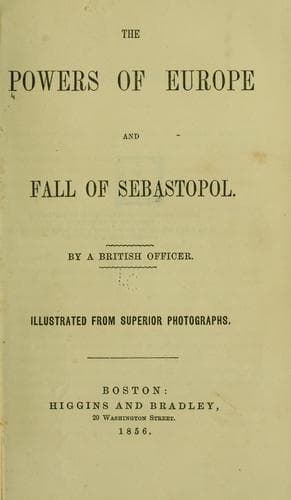
The Powers of Europe and Fall of SebastopolA British officer
History
The Powers of Europe and Fall of Sebastopol
A British officer
Crimean War, 1853-1856; Europe -- History -- 1789-1900
Schamyl’s financial rule is ordinarily distinguished by extreme
economy, and he is said to possess large concealed treasures: but if
a valorous action is to be rewarded, or a hostile tribe won over,
he will expend great sums. He has instituted a regular system of
decorations, consisting of medals, epaulettes, and stars; while,
on the other hand, his criminal code contains a no less exactly
proportioned series of punishments, from the rag tied round the right
arm, which is the stigma affixed to the coward--to decapitation,
shooting, and stabbing to death. A stern and even-handed justice
characterizes all Schamyl’s judgments, and he would long since have
fallen a victim to the blood-feuds thus created against himself,
were it not for the watchful devotion of his body-guard, the
Murtosigators, who constantly surround him in public. The Imam gave
once in his own person a frightful earnest of his determination to
know no distinction of persons among the violators of his laws.
Early in his career, he made a solemn vow that he would put to death
whoever, under any circumstances, proposed to him submission to the
Giaour. The people of Tchetchenia were well acquainted with the
Imam’s oath; but in 1843, finding themselves threatened on all sides
by the Russians, and at the same time left without aid by Schamyl,
who was otherwise occupied, they in despair sent messengers to the
latter, begging him either to help them, or to allow them to submit.
The office of the envoys was regarded as so hazardous, that their
selection was made by the lot. It fell upon four men of the village
Gunoi, who accordingly set out upon their mission. Before reaching
Dargo, Schamyl’s residence, however, the prospect of success appeared
so slight, and the consequences of failure so appalling, that they
determined to “eke the lion’s with the fox’s skin,” and without
making any direct proposition to Schamyl himself, to endeavour to
influence him through his aged mother, the Khaness, who was known
to possess great influence over her son, and at the same time to
be, like all the mountaineers, by no means insensible to money. A
large bribe engaged the Khaness to undertake the dangerous task;
and in a private interview she opened the matter to the Imam. What
occurred between mother and son is unknown, but when the men of Gunoi
anxiously inquired the result of the negotiation, the Khaness, pale
and trembling, could only tell them that her son had determined to
inquire of Allah concerning their request--and even as they spoke,
it was proclaimed that the Imam had shut himself in the mosque, and
had commanded that all the people should gather about it and remain
fasting and praying till he reäppeared. Three days and nights, it is
said, did Schamyl remain invisible, the prostrate multitude without
rising higher and higher in fanatical exaltation, as their bodily
frames became exhausted. On the fourth morning, Schamyl appeared on
the flat roof of the mosque, surrounded by his Murids.
Public-domain text, read in full here on John Shaqi.
Reviews
Reviews
No reviews yet
Be the first to share your thoughts on this work.
Elsewhere in the archive
Join the Discussion
Join the discussion
Sign in to leave a comment or review.
Sign InorCreate an account