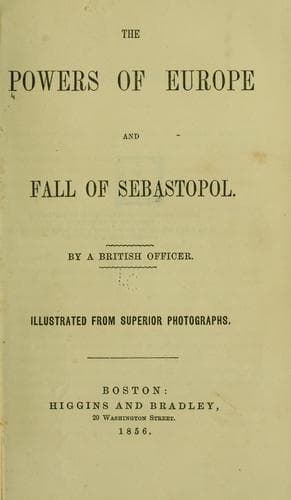
The Powers of Europe and Fall of SebastopolA British officer
History
The Powers of Europe and Fall of Sebastopol
A British officer
Crimean War, 1853-1856; Europe -- History -- 1789-1900
One copy of the epistle, however--such as it was--signed by General
Baraguay d’Hilliers, was intrusted to a French officer, commissioned
to deliver it to Prince Menschikoff in person. That officer embarked
on board H. M. S. _Retribution_, whose captain (Drummond), with
the copy bearing Lord Redcliffe’s signature, taking advantage of
a dense fog, and without any pilot, boldly steamed into the very
harbor of Sebastopol. Two shots were fired as a signal to bring
to, but they were disregarded; whereupon a Russian officer, in a
state of considerable excitement, hailed the frigate from a boat,
emphatically announcing that no vessel of war could be permitted
to enter the harbor, and that consequently the _Retribution_ must
forthwith retire. This requisition Captain Drummond refused to
comply with until the object of his mission had been accomplished.
He was then informed that the Governor was not in Sebastopol. The
commander of the _Retribution_ inquired for the deputy-governor,
to whom he delivered his despatches; and it is said that this
unfortunate officer was degraded to the ranks for permitting an
English man-of-war to make her way without opposition into a port so
jealously guarded.
While the parley between the English commander and the
deputy-governor was going on, the officers of the _Retribution_, by
the aid of cameras and pencils, took a series of sketches of the
works of Sebastopol, and thus made themselves masters of all the
information which the Russians had any interest in concealing.
On the 6th January, just as the allied fleets had taken possession of
the Black Sea in order to retain a “material guarantee” equivalent
to that of the Wallachian provinces, so unwarrantably seized by the
Czar, the army of Abdul Medjid on the Danube was preparing to prove
itself worthy of the important alliance he had just concluded.
His soldiers had shown well enough at Sinope that they knew how to
die: at Citate they satisfied Europe that they knew how to fight.
Though, for the most part, inexperienced levies, they were more than
a match for the veterans of the Czar, many of whom had for years past
been inured to hard fighting in the Caucasus, while many more had
seen something of warfare in the Hungarian campaign.
The Russians having determined to attack Kalafat, where Achmet Pacha
had resolved to establish himself in force, began to manœuvre so as
to reduce within the narrowest limits the Ottoman position: they
threw up also a considerable number of field-works, so as to command
almost every approach. Achmet Pacha felt that the moment had arrived
when it was incumbent upon him to act with vigor, if he did not wish
to break the spirit or lower the _morale_ of his men. Till the last
moment, however, he divulged his plans to no one; nor did he, till
the hour had arrived, intimate his intention of giving battle at
Citate, the nearest point to the enemy’s lines.
Public-domain text, read in full here on John Shaqi.
Reviews
Reviews
No reviews yet
Be the first to share your thoughts on this work.
Elsewhere in the archive
Join the Discussion
Join the discussion
Sign in to leave a comment or review.
Sign InorCreate an account