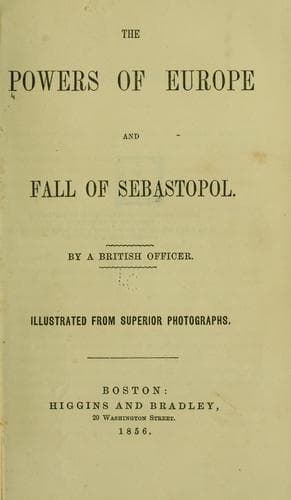
The Powers of Europe and Fall of SebastopolA British officer
History
The Powers of Europe and Fall of Sebastopol
A British officer
Crimean War, 1853-1856; Europe -- History -- 1789-1900
Citate is little more than a village, situate upon a gradual slope
commanding the surrounding plain, which is bounded by two ravines.
That on the eastern extremity is steep, abutting upon a lake, to the
rear of which is a long level tract, extending to the Danube. The
western gully is less abrupt, and inclines gradually towards a hill
behind the village. The main road to Kalafat lies in a north-westerly
direction between these ravines.
On a height above Citate, and to the left of the road, the Russians
had thrown up a redoubt, which subsequently had the effect of
preserving them from absolute destruction.
Achmet Pacha selected for this enterprise three regiments of cavalry,
thirteen battalions of infantry (altogether 11,000 men), and twenty
guns.
At sunset on the evening of the 5th January, the chosen band silently
quitted Kalafat, reaching the village of Maglovit at eight o’clock.
Some few found shelter in the deserted houses, but the greater part
bivouacked without fire and without shelter. The ground was covered
with half melted snow: the men were consequently compelled to keep on
foot till daybreak, when the bugle summoned them to proceed to the
scene of the impending action.
Two Turkish battalions were posted, with two guns, on the road, one
in the village of Maglovit, the other in that of Orenja, to keep
up the communication with Kalafat. A reserve of seven battalions
was stationed at the foot of the hill already alluded to, while the
other four battalions, with six guns (under the command of Ismail
Pacha, who led the attack), were posted somewhat in advance. The
day dawned fair, the air was clear and calm, and the sky cloudless.
Not a Russian sentry was visible, from the Turkish position, along
the whole valley of the Danube: from the unbroken silence it might
have been imagined that they had evacuated Citate. Six companies of
light infantry, headed by Teyfik Bey (the nephew of Omer Pacha), were
pushed forward _en tirailleurs_. They were on the point of occupying
the hill, when a heavy discharge of grape and canister plainly enough
revealed the presence of the enemy, as well as their intention of
disputing the position. A well-directed fire of musketry ensued, but
the Turkish sharpshooters, supported by four battalions of infantry
and a field battery, opened a murderous fire on the Russians, whose
artillery was miserably served in comparison with that of their
antagonists. They fought, however, with desperation; and as the
Turks advanced, carrying house after house at the bayonet’s point,
the Russians disputed every inch with all the frenzy of despair.
Quarter was neither asked nor given. Many of the Russian officers,
seeing their men give way, actually threw themselves on the swords of
the Mussulmans. The desperate struggle lasted more than four hours,
occasioning a heavy loss on both sides.
Public-domain text, read in full here on John Shaqi.
Reviews
Reviews
No reviews yet
Be the first to share your thoughts on this work.
Elsewhere in the archive
Join the Discussion
Join the discussion
Sign in to leave a comment or review.
Sign InorCreate an account