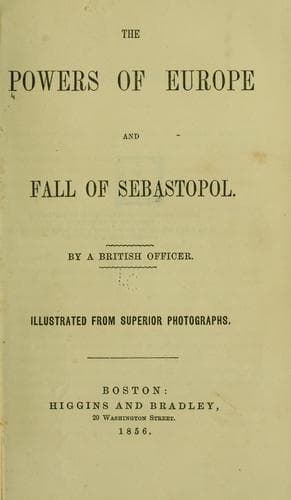
The Powers of Europe and Fall of SebastopolA British officer
History
The Powers of Europe and Fall of Sebastopol
A British officer
Crimean War, 1853-1856; Europe -- History -- 1789-1900
But the most important operation in this quarter was the attack, on
the 15th August, upon Bomarsund.
The disembarkation of the troops took place on the morning of the
8th August. The landing-place chosen was a bay about three miles
broad, to the south-west of the forts, and at a distance of 2500
yards from the western fort (called Fort Tzee). A Russian earthwork,
carrying six guns, had been placed on the eastern promontory of this
bay; but this battery was dismounted by the fire of the _Amphion_
and _Phlegethon_. Meantime, 11,000 men were landed in the space of
three hours and a half. The Russians made no attempt to oppose the
operation. The British and French marines, 600 of each flag, were
conveyed to the north of the forts, and landed behind them. The next
four days were employed in preparing for the attack. The positions
of the batteries were selected, sand-bags and gabions were prepared,
and the sailors brought up with great labor some long 32-pounders,
which were placed 800 yards from the round fort. On the 13th, the
fire of the French battery opened on Fort Tzee, and the bombardment
was sustained in the most brilliant manner for twenty-six hours. A
remarkable fact is, that this French battery consisted of only four
16-pounders and four mortars--a force quite inadequate to breach a
granite tower: three of the enemy’s guns were dismounted through the
embrasures, and the fire of the French rifles on these apertures was
so severe, that the Russians had difficulty in loading their guns,
and suffered most severely. Eventually this part of the work was
taken by the French chasseurs, on the morning of the 14th, by a _coup
de main_.
In the fort taken by the French, the Russian loss consisted of fifty
killed, twenty wounded, and thirty-five prisoners; on the side of
the French, Lieutenant Noulfe and two chasseurs were killed; 115
Russians were made prisoners. Hon. George Wrottesley, Lieutenant of
the Royal Engineers, was killed. Captain Ramsay, of Her Majesty’s
ship _Hogue_, was slightly wounded. One of the English marines was
also killed. Two screw guard-ships, the _Hogue_ and the _Edinburgh_,
and steamers, bombarded the forts for five hours, throwing their shot
with great effect from a distance of 3000 yards.
The large fortress did not surrender till the 16th. General Bodisco
and the Vice-Governor Turuhielm, with the whole garrison of 2000 men
(the _matériel_ and provisions), became prisoners of war, and were
sent on board the fleet.
The two forts taken were blown up. The main fortress was much
injured. The loss of the allies is put at 120 killed and wounded.
The Russian officials are reported to have taken to flight, pursued
by the peasantry. A proclamation was read in eleven parishes, by
order of General Baraguay d’Hilliers, freeing the Aland Islands
from Russian dominion, and placing them under the protection of the
Western Powers.
Public-domain text, read in full here on John Shaqi.
Reviews
Reviews
No reviews yet
Be the first to share your thoughts on this work.
Elsewhere in the archive
Join the Discussion
Join the discussion
Sign in to leave a comment or review.
Sign InorCreate an account