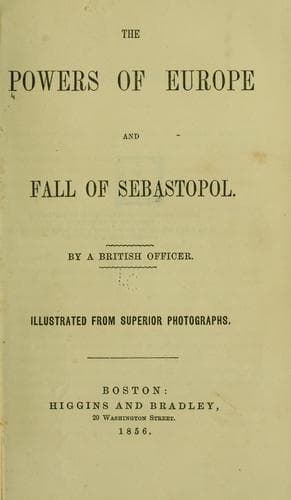
The Powers of Europe and Fall of SebastopolA British officer
History
The Powers of Europe and Fall of Sebastopol
A British officer
Crimean War, 1853-1856; Europe -- History -- 1789-1900
The result of the Baltic operations may be given in a few words. The
fleet of the Czar, outnumbered by that of the allied powers, was
detained in captivity at Helsingfors and Kronstadt, declining alike
every offer of battle, and unable to stay the devastation that was
effected along the Finnish shore of the Bothnian Gulf. Scarcely a
Russian merchant vessel escaped the vigilance of the cruisers; and
the whole line of her coasts, up to the shoals of Kettle Island, were
shown to be at the mercy of the allies. In a national point of view,
there was not much to boast of in the achievements of so stupendous
a fleet. But there were individual acts of valor as bright as any
that adorn the pages of naval history. Prominent among these was the
exploit of the _Arrogant_ and _Hecla_.
While the _Arrogant_ was reconnoitring Hango Bay, she was joined
by the _Hecla_, six guns, commanded by Captain Hall, so well known
for his services in the Chinese war. Early on the morning of the
20th May, they came within range of a battery, against which the
_Hecla_ opened fire, which was quickly returned. The _Arrogant_
aided the _Hecla_, and dispersed the defenders of the fort, blowing
gun-carriages to fragments and dismounting the guns. The town of
Eckness was descried, and the ships having been joined by the
_Dauntless_, the _Arrogant_ ran up alongside of a bark, took her
in tow, and steamed away with her. The ships were studded with
Minié balls. The _Arrogant_ had one man shot through the heart, and
another, badly wounded, lived only till next day. The _Hecla_ lost
one man. Captain Hall landed with his marines, and hoisted an iron
gun into his boat, which he placed on board the _Hecla_. They joined
the fleet on the 21st. The commander-in-chief telegraphed, “Well
done, _Arrogant_ and _Hecla_.”
But these successes were followed by a reverse sufficient to cast a
shade upon their career of triumph.
Admiral Plumridge’s flying squadron of paddle steamers, consisting
of the _Leopard_, the _Vulture_, the _Odin_, and the _Valorous_, had
been up the Gulf of Finland, and had destroyed forty-five vessels,
of from 1200 tons to 100 tons, and £300,000 worth of tar, timber,
saltpetre, and tallow. On the 7th of June, the _Vulture_ and _Odin_
were sent to Gamla-Karleby (64.50 north), where they had to anchor
five miles from the town. Their boats were sent in under the command
of the first lieutenant (Mr. Charles Wise) of the _Vulture_, who was
surprised by a large force of regular troops, armed with rifles and
field guns, wholly concealed and protected by strong wood stores, so
that not a man was seen. The consequence was, a murderous onslaught.
The loss from the _Vulture_ was one man killed and one wounded, and
a paddle-box boat, with one master (Mr. Murphy), twenty-seven men,
and the boat’s 34-pounder carronade, “missing, captured, or sunk.”
The loss from the _Odin_ was three officers killed and three men. The
first-lieutenant, one midshipman, and fifteen men were wounded.
Public-domain text, read in full here on John Shaqi.
Reviews
Reviews
No reviews yet
Be the first to share your thoughts on this work.
Elsewhere in the archive
Join the Discussion
Join the discussion
Sign in to leave a comment or review.
Sign InorCreate an account