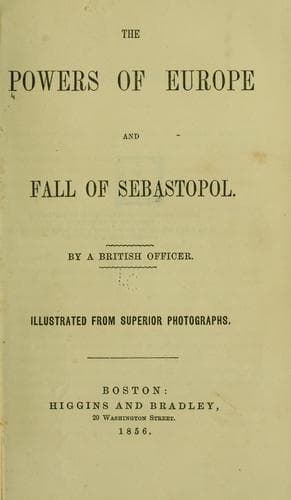
The Powers of Europe and Fall of SebastopolA British officer
History
The Powers of Europe and Fall of Sebastopol
A British officer
Crimean War, 1853-1856; Europe -- History -- 1789-1900
Then commenced one of the most bloody and determined struggles in
the annals of war. The 2nd Division, led by Sir de Lacy Evans in
the most dashing manner, crossed the stream on the right. Brigadier
Pennefather (who was in the thickest of the fight, cheering on his
men), again and again was checked, but never drew back in his onward
progress, which was marked by a fierce roll of Minié musketry; and
Brigadier Adams bravely charged up the hill, and aided him in the
battle. Sir George Brown, conspicuous on a grey horse, rode in front
of his Light Division, urging them with voice and gesture. Gallant
fellows! they were worthy of such a gallant chief. Down went Sir
George in a cloud of dust in front of the battery. He was soon up,
and led them on again; but in the shock produced by the fall of their
chief, the gallant regiment suffered terribly while paralysed for
a moment. Meantime, the Guards on the right of the Light Division,
and the brigade of Highlanders, were storming the heights on the
left. Suddenly a tornado of round and grape rushed through from the
terrible battery, and a roar of musketry from behind it thinned their
front ranks by dozens. It was evident that the troops were just able
to contend against the Russians, favored as they were by a great
position. At this very time an immense mass of Russian infantry
were seen moving down towards the battery. They halted. It was the
crisis of the day. Sharp, angular, and solid, they looked as if they
were cut out of the solid rock. Lord Raglan saw the difficulties of
the situation. He asked if it would be possible to get a couple of
guns to bear on these masses. The reply was “Yes;” and an artillery
officer brought up two guns to fire on the Russian squares. The first
shot missed, but the next, and the next, and the next, cut through
the ranks so cleanly, and so keenly, that a clear lane could be seen
for a moment through the square. After a few rounds the columns of
the square became broken, wavered to and fro, broke, and fled over
the brow of the hill, leaving behind them six or seven distinct
lines of dead, lying as close as possible to each other, marking the
passage of the fatal messengers. This act relieved the infantry of
a deadly incubus, and they continued their magnificent and fearful
progress up the hill. “Highlanders,” said Sir C. Campbell, ere
they came to the charge, “don’t pull a trigger till you’re within
a yard of the Russians!” They charged, and well they obeyed their
chieftain’s wish; Sir Colin had his horse shot under him; but he was
up immediately, and at the head of his men. But the Guards pressed on
abreast, and claimed, with the 33rd, the honor of capturing a cannon.
The Second and Light Division crowned the heights. The French turned
the guns on the hill against the flying masses, which the cavalry
in vain tried to cover. A few faint struggles from the scattered
infantry, a few rounds of cannon and musketry, and the enemy fled to
Public-domain text, read in full here on John Shaqi.
Reviews
Reviews
No reviews yet
Be the first to share your thoughts on this work.
Elsewhere in the archive
Join the Discussion
Join the discussion
Sign in to leave a comment or review.
Sign InorCreate an account