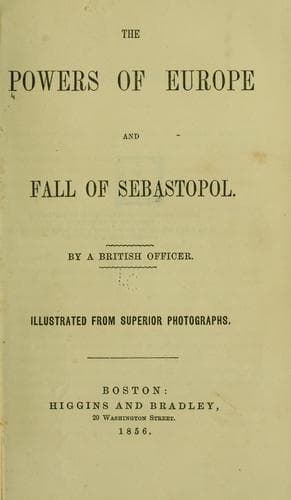
The Powers of Europe and Fall of SebastopolA British officer
History
The Powers of Europe and Fall of Sebastopol
A British officer
Crimean War, 1853-1856; Europe -- History -- 1789-1900
the South-east, leaving three Generals, three guns, 700 prisoners,
and 4000 killed and wounded, behind them.
The loss on the part of the British was 2000 killed, wounded, and
missing; that of the French, about 1400.
On the night after the battle the allied army bivouacked on the
summit of the heights which they had so gloriously won; the French
Marshal pitching his tent on the very spot occupied by that of Prince
Menschikoff the morning before.
THE MARCH TO SEBASTOPOL.
On the 23d the Allied armies left the Alma and proceeded to cross
the Katcha; on the 24th they crossed the Belbec, where it had been
intended to effect the landing of the siege _matériel_ with a
view to an attack on the north side of Sebastopol. It was found,
however, that the enemy had placed a fortified work so as to prevent
the vessels and transports from approaching this river; and it was
determined to advance at once by a flank march round the east of
Sebastopol, to cross the valley of the Tchernaya, and seize Balaklava
as the future basis of operations against the south side of the
harbor at Sebastopol.
On leaving the high road from the Belbec to Sebastopol, the army had
to traverse a dense wood, in which there was but one road that led
in the direction necessary to take. The march was toilsome, and the
troops suffered much from want of water. At length, about mid-day,
Lord Raglan and his staff, preceding the light division, arrived at
the outskirts of the wood, in the neighbourhood of a place known as
Mackenzie’s Farm, and, no doubt to the surprise of both parties,
found himself on the flank of a Russian division retreating from
Sebastopol to Bakshi-serai. The Russians only thought of making
good their retreat, and before any of the British cavalry and horse
artillery could be brought up, they had passed by the critical spot.
A few men fell on the side of the Russians, and some were taken
prisoners. A vast quantity of ammunition and much valuable baggage,
fell into the hands of the British.
After resting for awhile at Mackenzie’s Farm, where two wells
afforded a scanty supply of water to the thirsty troops, the march
was resumed down a steep and difficult defile, leading to the valley
of the Tchernaya river, which they succeeded in reaching the same
night.
Next morning (the 26th) the army was again on the march, and a few
miles more sufficed to bring them to the end of their journey.
The enemy did not hold Balaklava in any strength. After a few shots
the little garrison surrendered, and as Sir E. Lyon’s ship, the
Agamemnon, reached the mouth of the harbour at the very time that the
troops appeared on the heights, the British army was once more in
full communication with the fleet.
Public-domain text, read in full here on John Shaqi.
Reviews
Reviews
No reviews yet
Be the first to share your thoughts on this work.
Elsewhere in the archive
Join the Discussion
Join the discussion
Sign in to leave a comment or review.
Sign InorCreate an account