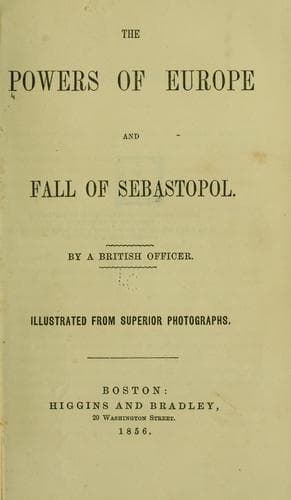
The Powers of Europe and Fall of SebastopolA British officer
History
The Powers of Europe and Fall of Sebastopol
A British officer
Crimean War, 1853-1856; Europe -- History -- 1789-1900
Lord Fitzroy Somerset was then under one-and-twenty, and it was
not the first battle he had seen since he landed in the Peninsula.
He learned much of his military science within the lines of Torres
Vedras, and was severely wounded at the battle of Busaco.
[Illustration: LORD RAGLAN]
By this time, the young soldier had won the notice and strong
regard of Wellington, who had made him, first, his aide-de-camp,
and then his military secretary, a singular honor for a man under
two-and-twenty. The duties of his various functions kept him
diligently occupied during the whole of the Peninsular War. He was
present and active in every one of the great Peninsular battles,
and was, in the intervals, the medium of the Duke’s commands and
arrangements. The Duke’s avowed opinion was, that the successes of
that seven years’ war were due, next to himself, to his military
secretary. He became Major in 1811, and Lieutenant-Colonel the year
after. He returned to England after Bonaparte’s abdication, in 1814.
Lord Fitzroy Somerset married in the August of that year the second
daughter of Lord Mornington, and thus became the nephew, by marriage,
of the Duke of Wellington. None then dreamed what misfortune
awaited the young bridegroom within the first year of his marriage.
On Napoleon’s return from Elba, the Secretary went out with the
Commander-in-Chief, and as his aide, he was on the field during the
three days of June, which ended the war.
The Duke was wont to offer to bear the responsibility of an omission
in the Battle of Waterloo--the neglecting to break an entrance in the
back wall of the farmstead of La Haye Sainte, whereby the British
occupants might have been reinforced and supplied with ammunition. It
was the want of ammunition which gave the French temporary possession
of the place, and that temporary possession cost many lives, and Lord
Fitzroy Somerset his right arm.
He came home to his bride thus maimed before he was twenty-seven, but
with whatever compensation an abundance of honor could afford. For
nearly forty years afterwards it was supposed by himself and the
world, that his wars were ended, and he devoted himself to official
service at home.
He entered Parliament in 1818. He was always in request for
secretaryships at the Ordnance and to the Commander-in-Chief. He rose
in military rank at intervals, and became a Lieutenant-General in the
year 1838.
When the Duke of Wellington died, and Lord Hardinge was made
Commander-in-Chief, Lord Fitzroy Somerset became Master-General of
the Ordnance, and was raised to the peerage by the title of Baron
Raglan.
It presently appeared that his wars were not over. During the long
interval he had sent out his eldest son in the service of his
country, and lost him in the field at Ferozeshah in 1845. Nine years
after this bereavement, the father went out himself once more, and
this time in full command.
Public-domain text, read in full here on John Shaqi.
Reviews
Reviews
No reviews yet
Be the first to share your thoughts on this work.
Elsewhere in the archive
Join the Discussion
Join the discussion
Sign in to leave a comment or review.
Sign InorCreate an account