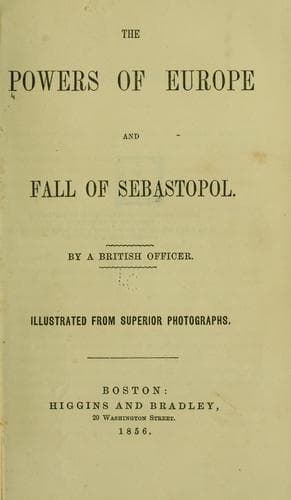
The Powers of Europe and Fall of SebastopolA British officer
History
The Powers of Europe and Fall of Sebastopol
A British officer
Crimean War, 1853-1856; Europe -- History -- 1789-1900
the Russian lancers.
At this moment the Russian artillerymen, returning to the guns
behind, sent a deadly shower of grape into the fighting mass of
horsemen, indiscriminately at friend and foe. The charge lasted
barely half-an-hour, and but 198 out of 800 returned to the British
lines.
Whilst the batteries were firing upon the retiring cavalry, a body of
French chasseurs d’Afrique charged at the guns erected on the left
of the valley, and forced them to retire. After sabering amongst the
Russian skirmishers, the chasseurs retired.
This closed the operations of the day. The Russians withdrew their
forces from the heights, and did not carry out their menaced attack
on Balaklava.
The bombardment of the forts before Sebastopol continued without
cessation all day.
Elated by their success against the Turks, and the capture of the
guns of the redoubts, the Russians attempted a sortie from Sebastopol
on the following day, the 26th October, whose strength exceeded 9000
infantry, with a numerous artillery; but no sooner had they entered
within range of the Allies’ guns, which, eighteen in number, had
taken up their position, than the word, “fire,” was given, and a
volley of shell tore open the ranks of the Russians, and checked
their advance. The guns being reloaded, a second discharge, no less
severe in its execution, caused the enemy to wheel round and retire.
A few rockets, dexterously discharged, transferred this retreat into
a rout. Upwards of 200 Russians were killed, and a large quantity of
muskets and sabres taken.
After this unsuccessful _sortie_ of the Russians, the siege continued
without any incident of particular interest to November 5th.
CHAPTER XV.
SIEGE OF SEBASTOPOL.
Lord Raglan--His Life--Battle of Inkerman--Morning of Battle
--Sons of Emperor Nicholas--The Attack--Troops Engaged--Fierce
Encounters--Sir George Cathcart--His Death--Russian Cruelty
--French Infantry--The Zouaves--Chasseurs--Russians Retire
--Renewed Attack--Repulsed by the French--Defeat--Sorties--Night
after Battle--Treaty with Austria of 2d Dec.--Negotiations for
Peace--The Four Points--Landing of Omer Pacha at Eupatoria--Death
of the Emperor Nicholas--Alexander II.--Fall of Sebastopol.
FIELD-MARSHAL LORD RAGLAN.
Lord Raglan, Commander-in-Chief of the English army, is a descendent
of the Somersets, the youngest son of the fifth Duke of Beaufort. He
was born in Sept. 1788, and christened Fitzroy James Henry Somerset.
He was a cornet in the 4th light dragoons at sixteen, and rose in
military rank, as the boyish sons of Dukes do rise, over the heads of
their seniors. He was a captain at twenty. He went with the troops
to Portugal, and fought in the first great battle--that of Talavera,
in which the French and English armies fairly and singly tried their
strength against each other.
Public-domain text, read in full here on John Shaqi.
Reviews
Reviews
No reviews yet
Be the first to share your thoughts on this work.
Elsewhere in the archive
Join the Discussion
Join the discussion
Sign in to leave a comment or review.
Sign InorCreate an account