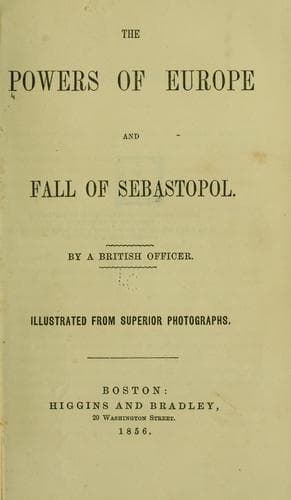
The Powers of Europe and Fall of SebastopolA British officer
History
The Powers of Europe and Fall of Sebastopol
A British officer
Crimean War, 1853-1856; Europe -- History -- 1789-1900
The enemy’s columns continued to push forward, trying to overwhelm
the British regiments with their superior numbers. “And now (to quote
the words of an eye-witness of the battle) commenced the bloodiest
struggle ever witnessed since war cursed the earth. It has been
doubted by military historians if any enemy have ever stood a charge
with the bayonet, but here the bayonet was often the only weapon
employed in conflicts of the most obstinate and deadly character.
Not only did the English charge in vain, not only were desperate
encounters between masses of men maintained with the bayonet alone,
but they were obliged to resist bayonet to bayonet, with the Russian
infantry again and again, as they charged the British with incredible
fury and determination.”
The battle of Inkerman admits of no description. It was a series
of dreadful deeds of daring, of sanguinary hand-to-hand fights, of
despairing rallies, of desperate assaults, in glens and valleys, in
brushwood glades and remote dells, hidden from all human eyes, and
from which the conquerors, Russian or British, issued, only to engage
fresh foes.
It was essentially a struggle between pluck and confidence, against
fearful odds and obstinate courage.
No one, however placed, could have witnessed even a small portion of
the doings of this eventful day, for the vapors, fog, and drizzling
mist, obscured the ground where the struggle took place to such an
extent, as to render it impossible to see what was going on at the
distance of fifty yards. Besides this, the irregular nature of the
ground, the rapid fall of the hill towards Inkerman, where the
deadliest fight took place, would have prevented one, under the most
favorable circumstances, seeing more than a very insignificant and
detailed piece of the terrible work below.
* * * * *
It was six o’clock when all the Head-quarter camp was roused by roll
after roll of musketry on the right, and by the sharp report of
field-guns.
Lord Raglan was informed that the enemy were advancing in force,
and soon after seven o’clock he rode towards the scene of action,
followed by his staff, and accompanied by Sir John Burgoyne,
Brigadier General Strangways, and several aides-de-camp.
As they approached the volume of sound, the steady unceasing thunder
of gun, and rifle, and musket, told that the engagement was at its
height. The shell of the Russians, thrown with great precision, burst
so thickly among the troops that the noise resembled continuous
discharges of cannon, and the massive fragments inflicted death on
every side.
Public-domain text, read in full here on John Shaqi.
Reviews
Reviews
No reviews yet
Be the first to share your thoughts on this work.
Elsewhere in the archive
Join the Discussion
Join the discussion
Sign in to leave a comment or review.
Sign InorCreate an account