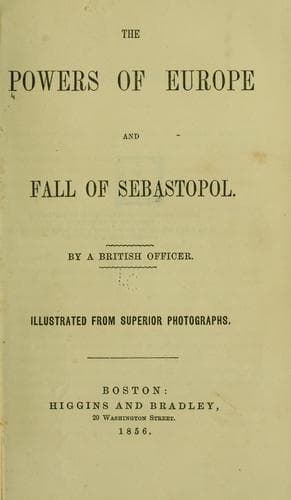
The Powers of Europe and Fall of SebastopolA British officer
History
The Powers of Europe and Fall of Sebastopol
A British officer
Crimean War, 1853-1856; Europe -- History -- 1789-1900
Colonel Gambier was at once ordered to get up two heavy guns
(eighteen pounders) on the rising ground, and to reply to a fire
which the light guns were utterly inadequate to meet. As he was
engaged in this duty he was severely wounded, and obliged to retire.
His place was taken by Lieutenant-Colonel Dickson, who, in directing
the fire of these two pieces, which had the most marked effect in
deciding the fate of the day, elicited the admiration of the army.
But long ere these guns had been brought up, there had been a great
slaughter of the enemy, and a heavy loss of the British. The
generals could not see where to go. They could not tell where the
enemy were--from what side they were coming, or where going. In
darkness, gloom, and rain, they led the lines through thick scrubby
bushes and thorny brakes, which broke the ranks, and irritated the
men, while every place was marked by a corpse or man wounded from an
enemy whose position was only indicated by the rattle of musketry,
and the rush of ball and shell.
Sir George Cathcart, seeing his men disordered by the fire of a
large column of Russian infantry, which was outflanking them, while
portions of the various regiments composing his division were
maintaining an unequal struggle with an overwhelming force, went down
into a ravine in which they were engaged to rally them. He rode at
their head encouraging them, and when a cry arose that the ammunition
was failing, he said coolly, “Have you not got your bayonets?” As he
led on his men, it was observed that another body of men had gained
the top of the hill behind them on the right, but it was impossible
to tell whether they were friends or foes. A deadly volley was poured
into the scattered British regiments. Sir George cheered them, and
led them back up the hill, but a flight of bullets passed where he
rode, and he fell from his horse close to the Russian columns. His
body was recovered mutilated with bayonet wounds.
When he fell, Colonel Seymour, who was with him, instantly
dismounted, and was endeavoring to raise the body, when he himself
received a ball which fractured his leg. He fell to the ground beside
his general, and a Russian officer and five or six men running
in, bayoneted him, and cut him to pieces as he lay helpless. The
Russians bayoneted the wounded in every part of the field, giving
no quarter, and apparently determined to exterminate the Allies, or
drive them into the sea.
Public-domain text, read in full here on John Shaqi.
Reviews
Reviews
No reviews yet
Be the first to share your thoughts on this work.
Elsewhere in the archive
Join the Discussion
Join the discussion
Sign in to leave a comment or review.
Sign InorCreate an account