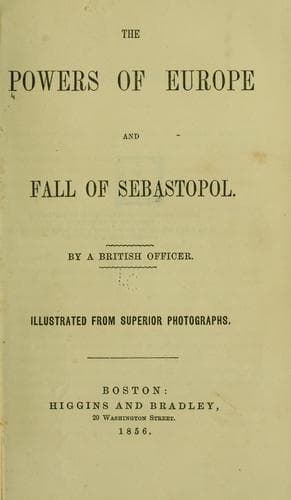
The Powers of Europe and Fall of SebastopolA British officer
History
The Powers of Europe and Fall of Sebastopol
A British officer
Crimean War, 1853-1856; Europe -- History -- 1789-1900
The renewed assault was so admirably managed that the Russians
sullenly retired, still protected by their crushing artillery.
The loss sustained by the English army was 2,400 killed or wounded:
of the French, 1,726. The Russians, in killed, wounded, and
prisoners, 15,000.
THE NIGHT AFTER THE BATTLE.
An eye-witness thus describes the night after the battle:
“On the evening of the battle I went over the field. All the wounded
had been removed. There is nothing so awful as the spectacle of the
bodies of those who have been struck down by round shot or shell.
Some had their heads taken off by the neck, as with an axe; others,
their legs gone from their hips; others their arms; and others again,
who were hit in the chest or stomach, were literally as mashed as
if they had been crushed in a machine. Passing up to Sebastopol,
over heaps of Russian dead, I came to the spot where the Guards had
been compelled to retire from the defence of the wall above Inkerman
valley. Here the dead of the Allies were nearly as numerous as the
enemy’s. Beyond this the Russian Guardsmen and line regiments lay
as thick as leaves; intermixed with dead and wounded horses. The
path lay through thick brushwood, but it was slippery with blood,
and the brushwood was broken down and encumbered with the dead. The
scene from the battery was awful beyond description. I stood upon its
parapet at about nine at night, and felt my heart sink as I gazed
upon the scene of carnage around.
“The moon was at its full, and showed every object as if by the light
of day. Facing me was the valley of Inkerman, with the Tchernaya,
like a band of silver, flowing gracefully between the hills, which,
for varied and picturesque beauty, might vie with any part of the
world.
“Yet I shall never recall the memory of Inkerman valley with any but
feelings of horror; for round the spot from which I surveyed the
scene lay upwards of five thousand bodies.
“Some lay as if prepared for burial, and as though the hands of
relatives had arranged their mangled limbs; while others again were
in almost startling positions, half standing or kneeling, clutching
their weapons or drawing a cartridge.
“Many lay with both their hands extended towards the sky, as if to
avert a blow or utter a prayer; while others had a malignant scowl
of fear and hatred. The moonlight imparted an aspect of unnatural
paleness to their forms, and as the cold, damp wind swept round the
hills and waved the boughs above their upturned faces, the shadows
gave a horrible appearance of vitality; and it seemed as if the dead
were laughing, and about to rise. This was not the case on one spot,
but all over the bloody field.”
The whole of the 6th (the day after the battle) was devoted to the
sorry task of burying the dead. A council of war was held, presided
over by Lord Raglan, at which it was determined to winter in the
Crimea, and orders were issued accordingly.
Public-domain text, read in full here on John Shaqi.
Reviews
Reviews
No reviews yet
Be the first to share your thoughts on this work.
Elsewhere in the archive
Join the Discussion
Join the discussion
Sign in to leave a comment or review.
Sign InorCreate an account