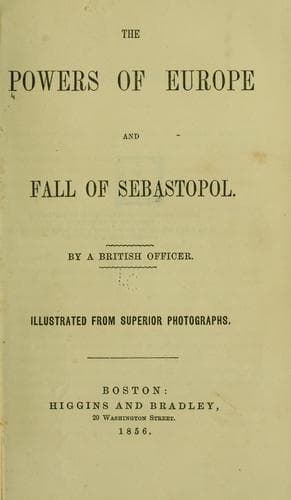
The Powers of Europe and Fall of SebastopolA British officer
History
The Powers of Europe and Fall of Sebastopol
A British officer
Crimean War, 1853-1856; Europe -- History -- 1789-1900
Large reinforcements were demanded both by Lord Raglan and General
Canrobert, which, with considerable promptitude, have been despatched
by their respective governments, and many of them are already on the
spot.
In the period which has elapsed since the battle of Inkerman no
battle has been fought. The usual routine of siege operations has
gone on; sorties have taken place from the besieged city, both upon
the French and English lines, which have, in every instance, been
victoriously repulsed. But a more formidable enemy than the Czar of
all the Russias has taken the field against the Allies. Winter, with
his chilling aspect and freezing breath, accompanied by his suite of
sleet and storm, and hurricane and snow, has made his appearance more
terrible than for many a year past. At times all operations have been
suspended; the trenches filled with water, and many a shivering form
has laid itself down without even the comfort of a plank between it
and the dripping earth to dream of home and to die. The sufferings of
such are known only to Him who tempers the wind to the shorn lamb.
On the 14th November, one of the fiercest storms known within the
memory of man burst over the Black Sea. Off Balaklava, where the
cliffs are steep and abrupt, eight transports became total wrecks,
and every soul on board but 30 perished.
A magnificent new steamer, the “Prince,” of 3,000 tons burden, having
arrived but a few days previously from England, and landed in safety
the 46th regiment, was obliged to anchor outside in consequence of
the crowded state of the harbor. The hurricane took her unawares,
and was so severe that her cables parted; the roaring surf tossed her
like an egg-shell upon the rocks, and the next instant nothing but a
wreathing mist could be seen hanging over the spot where her noble
timbers lay buried. Out of 150 souls on board, but six were saved.
Her cargo was invaluable at that particular time, and consisted of
a great portion of the winter clothing for the troops, including
40,000 suits of clothes, and large quantities of shot, shell, and
medical stores. Altogether, 18 British and 12 French ships were lost
at Balaklava.
Off the Katcha, five English and eight French ships were cast ashore.
At Eupatoria, the Henri IV., a French ship of the line, the French
war-steamer, Pluton, seven French and five English transports, and a
Turkish line-of-battle ship, were driven on shore.
During the confusion of the storm, an attack was made on the town of
Eupatoria by 4,000 Russian cavalry, with 14 pieces of artillery, but
was gallantly repulsed by the cannon and rockets of the garrison.
The continuance of unfavorable weather has rendered the camps almost
untenable, and the roads impassable. The British government, to
obviate the difficulty, have sent out all the materials necessary for
the construction of a railroad from Balaklava to Sebastopol heights,
with a sufficient number of navvies (or laborers) to complete the
same at an early day.
Public-domain text, read in full here on John Shaqi.
Reviews
Reviews
No reviews yet
Be the first to share your thoughts on this work.
Elsewhere in the archive
Join the Discussion
Join the discussion
Sign in to leave a comment or review.
Sign InorCreate an account