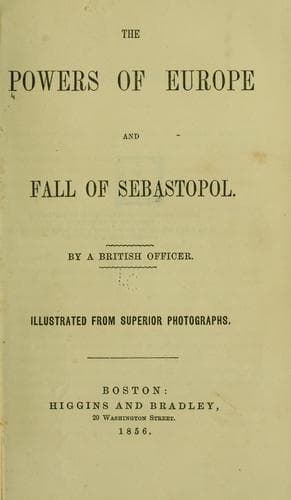
The Powers of Europe and Fall of SebastopolA British officer
History
The Powers of Europe and Fall of Sebastopol
A British officer
Crimean War, 1853-1856; Europe -- History -- 1789-1900
But with the British it is quite the reverse. Once in the ranks the
soldier hopes for no higher position, because it is unattainable.
Their officers are selected, not on the ground of merit, but because
by chance born a “Somerset” or in the shadow of a title. By education
well fitted to shine at court, or amid the butterflies of fashion,
practical knowledge and business capacity are things of which they
have never dreamed, and which so savors of the plebeian that they are
led to believe themselves degraded by giving attention to details, or
in the exhibition of that energy which is the secret of success in
every calling.
While the execution of these minor details renders the French
comparatively comfortable on the heights of Sebastopol, the British,
for lack of them, are undergoing the horrors of the campaign of
Moscow.
With a superabundance of everything on board ship; with cargoes of
furs and warm clothing at Balaklava, the soldiers on half rations
are suffering famine, and in summer garments are shivering and dying
in the cold blasts of a Crimean winter. By the humanity of their
allies, some have been protected from freezing by donations of the
well known Algerine caban (heavy cloaks with hoods), from the French;
and the British army presents the strange and humiliating spectacle
of appearing in French habiliments and sacrificing its identity. If
the present disasters in the Crimea shall have the effect to cause a
breaking down of that Feudal system in England, which recognises one
man as entitled to all privileges, and his neighbor to none; which,
regardless of capacity, places _names_ rather than men in command
of armies, and in cabinets: if this change shall be effected, then
will more good have been accomplished than would result from the
subjugation of Russia and downfall of Sebastopol.
[Illustration: NICHOLAS, LATE EMPEROR OF RUSSIA.]
CHAPTER XVI.
SIEGE OF SEBASTOPOL.
Siege of Sebastopol continues--Sardinia joins the Western Alliance
--Battle of Eupatoria--Sudden death of Emperor Nicholas--His
love and pride for his Army--His last Words--Alexander II.
ascends the Throne--His Manifesto to his Subjects--A Sketch of
him--Recall of Prince Menschikoff from command in the Crimea
--His abilities and failings--His Successors--Gortschakoff’s
Military Career.
The conference at Vienna not having arrived at any definite terms of
adjustment for Peace, the siege of Sebastopol was continued, although
the severity of the weather would not admit of active operations from
the besiegers or the besieged; the Allies were busied in drawing
their lines closer to the walls, which provoked occasional sorties
from the Russians, of small detachments of troops, which were quickly
repulsed.
Public-domain text, read in full here on John Shaqi.
Reviews
Reviews
No reviews yet
Be the first to share your thoughts on this work.
Elsewhere in the archive
Join the Discussion
Join the discussion
Sign in to leave a comment or review.
Sign InorCreate an account