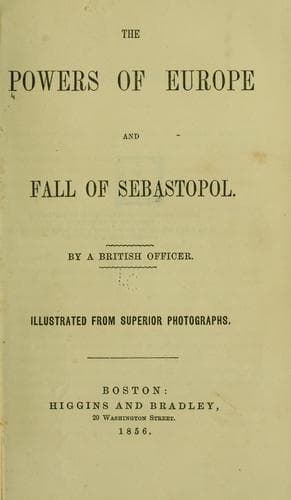
The Powers of Europe and Fall of SebastopolA British officer
History
The Powers of Europe and Fall of Sebastopol
A British officer
Crimean War, 1853-1856; Europe -- History -- 1789-1900
No cessation of hostilities has taken place; no armistice will be
listened to, and the siege goes on. Enormous preparations have been
made both by the French and English, for continuing their operations
with increased vigor as soon as the weather will permit. Omer Pacha
has been ordered, with his army of forty thousand men, to proceed to
Eupatoria, where he has landed, and will be able to operate on the
rear of the Russians, while the British and French attack in front,
and if kept well supplied both with men and means, we may expect
something brilliant from his well-earned prowess and reputation.
Whether we are approaching the close of the war, or the beginning
of it, is a question which no human foresight can, at the present
moment, determine.
The question is one of deep importance to the world generally, for
war brings so many evils in its train, is so exhausting in blood
and treasure, interrupts the commercial transactions of nations so
painfully, and retards civilization so seriously, that we cannot but
hope that the year which thus commences with slaughter may close in
peace.
A winter campaign under the most favorable circumstances is rife with
suffering and death; but much can be done to mitigate these evils by
a system of thorough discipline on the part of those in command.
Every arrival, however, from the Crimea, brings tales of woe
and misery coupled with additional confirmation of the gross
mismanagement which has characterized the conduct of the British army
since its first arrival in the East. In battle, British officers
and soldiers have proved themselves heroes, yet in the organization
of the different departments, in everything which contributes to
the comfort and health both of officers and men, as well as in the
commissariat, they have proved themselves lamentably deficient.
In contrast with the admirable organization of the French army under
similar circumstances, it would seem difficult to account for the
comparative comfort in the one case, and the miserable lack of it in
the other; but upon a careful analysis of the two systems, the cause
becomes at once apparent. The French army is essentially a democratic
institution, in which promotion depends entirely upon individual
merit. Vigilance, activity, and energy is the price of position, and
with a possibility of attaining a higher rank, the common soldier
as well as the officer, has an incentive for extra exertion, and
something to hope for in the future.
Public-domain text, read in full here on John Shaqi.
Reviews
Reviews
No reviews yet
Be the first to share your thoughts on this work.
Elsewhere in the archive
Join the Discussion
Join the discussion
Sign in to leave a comment or review.
Sign InorCreate an account