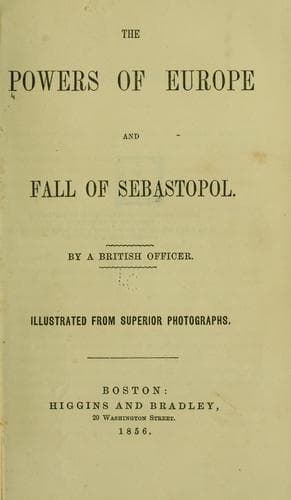
The Powers of Europe and Fall of SebastopolA British officer
History
The Powers of Europe and Fall of Sebastopol
A British officer
Crimean War, 1853-1856; Europe -- History -- 1789-1900
A few hours after the death of the Czar Nicholas, his son, heir,
and successor, Alexander II., ascended the throne and the officers
of the imperial house took the oaths of allegiance. The new Emperor
in his manifesto to his subjects says--as his father devoted
himself incessantly for the welfare of his Empire, “so do we also
on ascending the throne of Russia, and of Poland and Finland,
inseparable from it, take a solemn oath before God to regard the
welfare of our Empire as our only object. May Providence, which has
selected us for so high a calling, be our guide and protector, that
we may maintain Russia on the highest standard of power and glory,
and in our person accomplish the incessant wishes and views of
Peter, of Catharine, of Alexander, and of our father. May the zeal
of our subjects assist us therein. We invoke and command the oath of
allegiance to us, and to the heir to the throne, our son Nicholas
Alexandrowitsch.” The new Sovereign of Russia is thirty-seven years
of age, his figure tall and commanding, his features fine, with
a Grecian profile, an expression of kindness, a step light and
gracefully noble. Previous to his accession, he held the posts of
Commander-in-Chief of the Corps de la Garde, and of the Grenadiers;
presided over the Military School, and was Curator-in-Chief of the
Military Hospital of Tchesmé, and holds the command of the Lancers,
the Carabiniers of Erivan, &c.
He was initiated, at an early age, into the affairs of the Empire
by the Emperor his father; he was present at all the councils; he
was invested with situations which gave him frequent opportunities
of rendering himself useful to the army, and pleasing to the youth
of the schools. Whenever the Emperor Nicholas quitted the capital,
he left the supreme direction of the Government to his son; in
short, he had taken the utmost pains to prepare him to become his
successor. The new Emperor is very popular in Russia--he is beloved
and esteemed by the people. He will not exercise the great authority
of his father, for he does not inherit either his hauteur or his
inflexibility. He will rather please, as the Emperor Alexander I.
did, by his mildness and his affability; and between the uncle and
the nephew there is a very great similarity of character in numerous
ways. The new Empress is also highly spoken of, and her elevated
judgment and her conciliating manners are much extolled. It is
thought she will exercise a salutary influence over the Emperor.
Public-domain text, read in full here on John Shaqi.
Reviews
Reviews
No reviews yet
Be the first to share your thoughts on this work.
Elsewhere in the archive
Join the Discussion
Join the discussion
Sign in to leave a comment or review.
Sign InorCreate an account