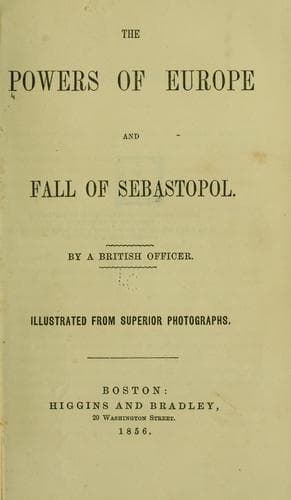
The Powers of Europe and Fall of SebastopolA British officer
History
The Powers of Europe and Fall of Sebastopol
A British officer
Crimean War, 1853-1856; Europe -- History -- 1789-1900
One of the last acts of the late Emperor of Russia was the
recalling of Prince Menschikoff from the command he has held in
the Crimea since the commencement of hostilities. He was chosen
by the late Emperor as one of the principal members of the old
Muscovite party in the state to proceed on the mission to the
Porte, which gave the signal of the contest. He performed the
mission with arrogance--unconciliating, and even uncouth in his
manners--unacquainted with the forms of diplomatic intercourse or the
political dangers he called into life--Prince Menschikoff succeeded
in nothing but in rousing the spirit of the Divan to all the ardor
of resistance, and in enlisting the sympathy of Europe on the side
of his victim. In his capacity of Admiral, Head of the Fleet, and
Minister of Marine, he continued with great energy to face the storm
he had drawn down upon his country; and it must be acknowledged that
he showed great energy and inexhaustible resource in the defence of
Sebastopol. There is no example in history of defences and works of
so extensive a character thrown up by a besieged garrison in presence
of a powerful enemy; and the highest compliment which can be offered
to Prince Menschikoff is the simple statement of fact, that on the
26th of September the place was almost open, and only defended by the
vessels in the harbor; but that five months later, and in spite of
continued attacks, the town was supposed by many persons impregnable
to any direct assault.
Prince Gortschakoff, who was in command of the Russian forces in the
Principalities, was appointed to take command in the Crimea, and Gen.
Osten Sacken was appointed second in command.
Prince Gortschakoff is one of those who has attained his present
eminent position by ascending, spoke by spoke, the “ladder of fame.”
The first that was known of him as a military man was his serving
in a subordinate rank in the Artillery of the Imperial Guards. This
was in the year 1828, he being then about thirty years of age.
In 1829 he formed one of the staff of the Kratsowski Corps, and
served with them in Silistria and at Shumla--he took part, together
with Gen. Krassoffsky, in artillery operations connected with the
beleaguerment of Silistria. After a siege of six weeks the garrison
surrendered as prisoners of war. In 1831 Gortschakoff was required to
take part in the war in Poland; and for his services in the campaign
he was advanced to the rank of Lieutenant-General.
Public-domain text, read in full here on John Shaqi.
Reviews
Reviews
No reviews yet
Be the first to share your thoughts on this work.
Elsewhere in the archive
Join the Discussion
Join the discussion
Sign in to leave a comment or review.
Sign InorCreate an account