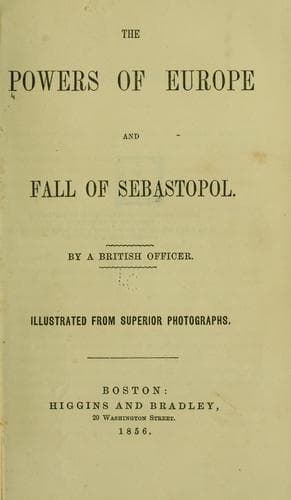
The Powers of Europe and Fall of SebastopolA British officer
History
The Powers of Europe and Fall of Sebastopol
A British officer
Crimean War, 1853-1856; Europe -- History -- 1789-1900
At dawn on the morning of the 5th of September, 1855, the expected
bombardment commenced on a scale of unprecedented magnitude. The last
and decisive cannonade was begun on Wednesday by the French, who
exploded three fougasses to blow in the counterscarp, and to serve
as a signal to their men. Instantly from the sea to the Dockyard
creek there was seen to run a stream of fire, and fleecy, curling,
rich white smoke, as though the earth had suddenly been rent in the
throes of an earthquake, and was vomiting forth the material of her
volcanoes. The lines of the French trenches were at once covered as
though the very clouds of heaven had settled down upon them and were
whirled about in spiral jets, in festoons, in clustering bunches,
in columns and in sheets, all commingled, involved together by the
vehement flames beneath.
After two hours and a half of furious fire, the artillery-men
suddenly ceased, in order to let their guns cool and to rest
themselves. The Russians crept out to repair the damages to their
works, and shook sandbags full of earth from the parquette over the
outside of their parapets.
At 10 o’clock, however, the French reöpened a fire, if possible,
more rapid and tremendous than their first, and continued to keep
it up with the utmost vigor till 12 o’clock at noon, by which time
the Russians had only a few guns in the Flagstaff road and Garden
Batteries in a position to reply. From 12 to 5 o’clock P. M., the
firing was slack; the French then resumed their cannonade with the
same astounding vigor as at dawn and at 10 o’clock, and never ceased
their volleys of shot and shell against the place till 7 1/2, when
darkness set in, and all the mortars and heavy guns, English as well
as French, opened with shell against the whole line of defences.
A description of this scene is impossible. There was not one instant
in which the shells did not whistle through the air--not a moment in
which the sky was not seamed by their fiery curves or illuminated by
their explosion.
THE SECOND DAY’S BOMBARDMENT.
_Sept. 6_--A steady fire was kept up along the front, to prevent
the Russians repairing damages. At 5 1/2 o’clock the whole of the
batteries from Quarantine to Inkermann opened with a grand crash. The
Russians were silent as before. The cannonade was maintained as it
was the day before. There were three breaks or lulls in the tempest;
from 8 1/2 till 10 o’clock, from 12 till 5, and from 6 1/2 till 7
o’clock the fire was comparatively slack.
THIRD DAY’S BOMBARDMENT.
_Sept. 7_--The cannonade was resumed at daybreak, the Inkermann
batteries firing briskly. A counsel of generals was held at
headquarters. The firing was tremendous all day, but clouds of dust
which a high wind from the north drifted, rendered a view of the
place impossible.
Public-domain text, read in full here on John Shaqi.
Reviews
Reviews
No reviews yet
Be the first to share your thoughts on this work.
Elsewhere in the archive
Join the Discussion
Join the discussion
Sign in to leave a comment or review.
Sign InorCreate an account