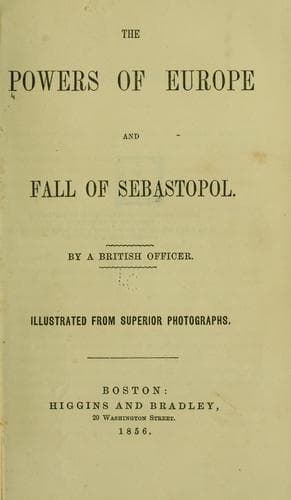
The Powers of Europe and Fall of SebastopolA British officer
History
The Powers of Europe and Fall of Sebastopol
A British officer
Crimean War, 1853-1856; Europe -- History -- 1789-1900
At Grochow, the Russians, under the command of Count Pahlen, had been
compelled to retreat before the Poles, when, by the concentration of
the artillery force under the command of Gortschakoff, the battle
was turned in favor of the Russians. At Ostrolenka, also, he greatly
distinguished himself. The Poles, after an obstinate resistance, were
compelled to abandon the place. In September, 1831, the capital,
Warsaw, capitulated. In 1843 he was promoted to the rank of General
of Artillery. In 1846 he was appointed Military Governor of Warsaw.
He took an important part in the Hungarian war of 1849. As soon as
the occupation of the Danubian provinces was determined upon, the
Prince was appointed to the chief command of the Imperial forces.
When he entered Wallachia, he published a proclamation, to the effect
that the Czar, his master, had no design of conquest, and that the
independence of the inhabitants would, in every way, be protected.
This promise was not fulfilled. Shortly after this, he issued the
celebrated appeal to the fanaticism of the Russians, ending with the
words--“Mort aux Pagans” (death to the infidels). As has been stated,
the Prince has gradually attained his present high rank.
He is now Aide-de-Camp General, General of Artillery, and Chef
d’Etat Major of the active army, and privileged to take part in
the deliberations of the Councils of the Empire. He is also
Military Governor of Warsaw, and the chief member of the Council of
Administration of the Kingdom of Poland.
The diplomatic achievements of the Prince are numerous, but they are
more characteristic than great. He is said to be more of a bully than
a diplomatist, doubles his fists too often to wear the “white glove”
well--he being one of the most petulant and factious of mankind, and
at the same time one of the most obstinate and overbearing.
THE FALL OF SEBASTOPOL.
It is nearly a year since we were first startled by the announcement
that Sebastopol had fallen. But that news proved false, and ever
since the public ear has been opened to catch the announcement of the
news of the great feat which two of the mightiest nations of the Old
World had combined their utmost power to accomplish. It has come at
last; superior power and skill have carried the day, as we have never
doubted they would, and Sebastopol has fallen.
The contest on which the eyes of Europe have been turned so long
is nearly decided--the event on which the hopes of so many mighty
empires depended is all but determined. And one more great act of
carnage has been added to the tremendous, but glorious tragedy, of
which the whole world, from the most civilized nations down to the
most barbarous hordes of the East, has been the anxious and excited
audience.
Public-domain text, read in full here on John Shaqi.
Reviews
Reviews
No reviews yet
Be the first to share your thoughts on this work.
Elsewhere in the archive
Join the Discussion
Join the discussion
Sign in to leave a comment or review.
Sign InorCreate an account