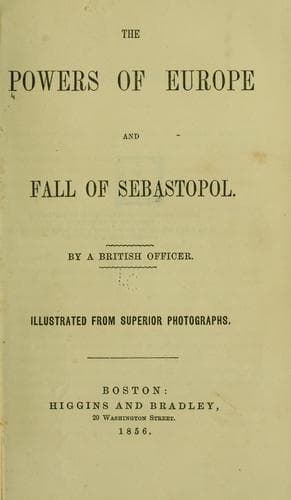
The Powers of Europe and Fall of SebastopolA British officer
History
The Powers of Europe and Fall of Sebastopol
A British officer
Crimean War, 1853-1856; Europe -- History -- 1789-1900
In consequence of the overbearing demands of Napoleon, the Swedish
Government allied itself with Russia on the 5th of April (1812), and
with Great Britain on the 12th of July following.
The differences between Alexander and Napoleon had now become so
serious, that war was inevitable. But Napoleon knew the foe he had
to grapple with, and proposed terms of peace to Great Britain on the
17th of April, hoping to be left to meet the Russians single-handed,
and thus humble the overweening pride of the Czar. His proposals
were, however, rejected.
Down to the very commencement of hostilities, notes continued to be
interchanged between the representatives of the two Emperors, which
did little more than recapitulate the mutual grounds of complaint of
the two cabinets against each other. Finally, on the 24th of April,
Alexander sent to Napoleon his ultimatum, offering an accommodation
on condition that France would evacuate Prussia, and come to an
arrangement with the king of Sweden which remained without any
answer, on the part of the French Government.
Both prepared for the worst, and on the 23d of June, Napoleon arrived
on the banks of the Niemen, with his countless hosts, for the
invasion of Russia.
The armies at his command, at this time, amounted in the aggregate,
to the enormous sum of 1,250,000 men; and the force which entered
Russia, during the year 1812, was 647,158 men--187,111 horses, and
1372 cannon.
The regular forces of the Russians amounted, at the close of 1811,
to 517,000 men, 70,000 of whom were in garrison, and the remainder
dispersed over an immense surface.
To oppose the invasion of the French, the Russians had collected
about 200,000 men, and upwards of 800 pieces of cannon. The forces
of the French, therefore, exceeded those of the Russians, by nearly
300,000 men; but the former were at an immense distance from their
resources, and had no means of recruiting their losses; whereas the
latter were in their own country, and supported by the devotion of a
fanatical and patriotic people.
The face of the country on the Western frontier of Russia is in
general flat, and in many places marshy; vast woods of pine cover the
plains, and the rivers flow in some places through steep banks, in
others stagnate over extensive swamps, which often present the most
serious obstacles to military operations. The villages are few and
miserable.
The wants of such a prodigious accumulation of troops speedily
exhausted all the means of subsistence which the country afforded,
and the stores they could convey with them. Forced requisitions from
the peasantry became, therefore, necessary, and so great was the
subsequent misery that the richest families in Warsaw were literally
in danger of starving, and the interest of money rose to 80 per cent.
Public-domain text, read in full here on John Shaqi.
The Powers of Europe and Fall of Sebastopol — John Shaqi
Reviews
Reviews
No reviews yet
Be the first to share your thoughts on this work.
Join the Discussion
Join the discussion
Sign in to leave a comment or review.
Sign InorCreate an account