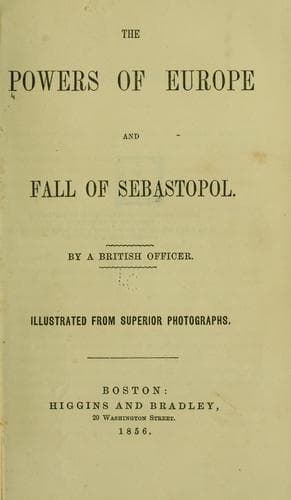
The Powers of Europe and Fall of Sebastopol — John Shaqi
The Powers of Europe and Fall of SebastopolA British officer
History
The Powers of Europe and Fall of Sebastopol
A British officer
Crimean War, 1853-1856; Europe -- History -- 1789-1900
assaults on the gates, from which he was repulsed, with great loss.
The Spaniards, having received a reinforcement, made a sortie to
retake Monte Torrero; but were defeated, their commander killed,
and most of their number left dead. On the 2d of August, the enemy
opened a dreadful fire on the town. One of their shells lighted upon
the powder magazine, which was in the most secure part of the city,
and blew it up, destroying many houses and killing numbers of the
besieged. The carnage, during this siege, was truly terrible. Six
hundred women and children perished, and above forty thousand men
were killed.
It was at this place that the act of female heroism so beautifully
celebrated by Byron was performed. An assault had been made upon one
of the gates, which was withstood with great courage by the besieged.
At the battery of the Portillo, their fire had been so fatal, that
but one artillery-man remained able to serve the gun. He seemed to
bear a charmed life. Though shot and shell fell thick and fast around
him, he still stood unharmed, and rapidly loaded and discharged his
gun. At length, worn out by his own exertions, his strength seemed
about to fail. There was little time, in a contest like this, to
watch for the safety of others; but there was one eye near which not
for a moment lost sight of him. Augustina, a girl twenty-two years
of age, had followed her daring lover to his post. She would not
leave him there alone, although every moment exposed her to share
his death. When she saw his strength begin to fail, she seized a
cordial, and held it to his lips. In the very act of receiving it,
the fatal death-stroke came, and he fell dead at her feet. Not for
a moment paused the daring maid. No tear fell for the slain. She
lived to do what he had done. Snatching a match from the hand of a
dead artillery-man, she fired off the gun, and swore never to quit it
alive, during the siege. The soldiers and citizens, who had begun to
retire, stimulated by so heroic an example, rushed to the battery a
second time, and again opened a tremendous fire upon the enemy. For
this daring act, Augustina received a small shield of honor, and had
the word “Saragossa” embroidered on the sleeve of her dress, with the
pay of an artillery-man. Byron thus commemorates this heroism, in his
own transcendent manner:
“The Spanish maid, aroused,
Hangs on the willow her unstrung guitar,
And, all unsexed, the anlace hath espoused,
Sung the loud song, and dared the deeds of war.
And she, whom once the semblance of a scar
Appalled, an owlet’s ’larum filled with dread,
Now views the column-scattering bayonet jar,
The falchion flash, and o’er the yet warm dead
Stalks with Minerva’s step, where Mars might quake to tread.
Public-domain text, read in full here on John Shaqi.
Reviews
Reviews
No reviews yet
Be the first to share your thoughts on this work.
Join the Discussion
Join the discussion
Sign in to leave a comment or review.
Sign InorCreate an account