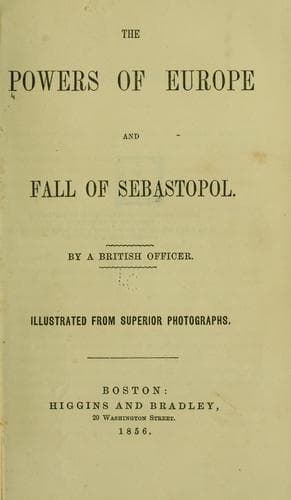
The Powers of Europe and Fall of SebastopolA British officer
History
The Powers of Europe and Fall of Sebastopol
A British officer
Crimean War, 1853-1856; Europe -- History -- 1789-1900
The contest which was now carried on stands unparalleled. One side
of the Corso was held by the French soldiery; the opposite was in
possession of the Arragonese, who erected batteries at the end of
the cross-streets, within a few paces of those the French had thrown
up. The space between these was covered with the dead. Next day,
the powder of the besieged began to fail; but even this dismayed
them not. One cry broke from the people, whenever Palafox came among
them, “War to the knife!--no capitulation.” The night was coming
on, and still the French continued their impetuous onsets. But now
the brother of Palafox entered the city with a convoy of arms and
ammunition, and a reinforcement of three thousand men. This succor
was as unexpected as it was welcome, and raised the desperate courage
of the citizens to the highest pitch of enthusiasm. The war was now
carried on from street to street, and even from room to room. A
priest, by the name of Santiago Suss, displayed the most undaunted
bravery, fighting at the head of the besieged, and cheering and
consoling the wounded and the dying. At the head of forty chosen men,
he succeeded in procuring a supply of powder for the town, and, by
united stratagem and courage, effected its entrance, even through
the French lines. This murderous contest was continued for eleven
successive days and nights,--more, indeed, by night than by day, for
it was almost certain death to appear by daylight within reach of
houses occupied by the other party. But, concealed by the darkness of
the night, they frequently dashed across the street, to attack each
other’s batteries; and the battle, commenced there, was often carried
into the houses beyond, from room to room, and from floor to floor.
As if not enough of suffering had accompanied this memorable siege,
a new scourge came to add its horrors to the scene. Pestilence, with
all its accumulated terrors, burst upon the doomed city. Numbers of
putrescent bodies, in various stages of decomposition, were strewed
thickly around the spot where the death-struggle was still going on.
The air was impregnated with the pestiferous miasma of festering
mortality; and this, too, in a climate like Spain, and in the month
of August! This evil must be removed,--but how? Certain death would
have been the penalty of any Arragonese who should attempt it. The
only remedy was to tie ropes to the French prisoners, and, pushing
them forward amid the dead and dying compel them to remove the
bodies, and bring them away for interment. Even for this office, as
necessary to one party as the other, there was no truce; only the
prisoners were better secured, by the compassion of their countrymen,
from the fire.
Public-domain text, read in full here on John Shaqi.
Reviews
Reviews
No reviews yet
Be the first to share your thoughts on this work.
Join the Discussion
Join the discussion
Sign in to leave a comment or review.
Sign InorCreate an account