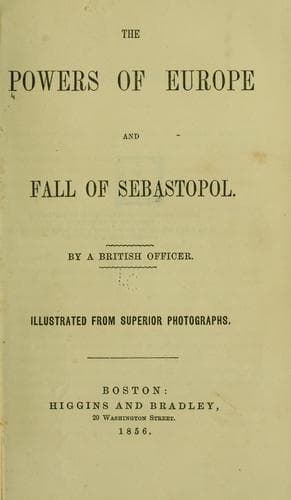
The Powers of Europe and Fall of SebastopolA British officer
History
The Powers of Europe and Fall of Sebastopol
A British officer
Crimean War, 1853-1856; Europe -- History -- 1789-1900
believed; and people, even of the higher classes, were often seen on
the highest points of the hills, looking towards the sea with earnest
gaze, for the appearance of the island where their long-lost hero was
detained.
The constant efforts of the English and the priests at length had
their effect, in arousing the Portuguese peasantry into action; and
the news of the insurrection in Spain added new fuel to the flame.
The Spaniards in Portugal immediately rose against the French; and
their situation would have become dangerous in the extreme, had
not the promptness and dexterity of Junôt succeeded in averting
the danger for the present. Such was the state of affairs in the
Peninsula, when the English troops made their descent into Spain.
It has often been said that England was moved by pure patriotism,
or by a strong desire to relieve the Spanish nation, in being thus
prodigal of her soldiers and treasures; but her hatred to Napoleon,
and her determination, at all hazards, to put a stop to his growing
power, was, in all probability, the real motive that influenced her
to bestow aid upon that people.
The English collected their army of nine thousand in Cork, in
June, 1808. Sir Hugh Dalrymple had, nominally the chief command of
the army, and Sir Harry Burrard the second; but the really acting
officers were, Sir Arthur Wellesley and Sir John Moore. These troops
disembarked at the Mondego river on the first of August, and marching
along the coast, proceeded to Rolica, where they determined to give
battle to the French. Junôt, having left in Lisbon a sufficient force
to hold the revolutionary movement in check, placed himself at the
head of his army, and advanced to the contest. He was not, however,
present at the battle of Rolica. The French troops were under the
command of Generals Loison and Laborde. Nearly in the centre of the
heights of Rolica stands an old Moorish castle. This, and every
favorable post on the high ground, was occupied by detachments of the
French army. It was a strong position; but Sir Arthur, anxious to
give battle before the two divisions of the French army should effect
a junction, decided upon an immediate attack.
Public-domain text, read in full here on John Shaqi.
Reviews
Reviews
No reviews yet
Be the first to share your thoughts on this work.
Join the Discussion
Join the discussion
Sign in to leave a comment or review.
Sign InorCreate an account