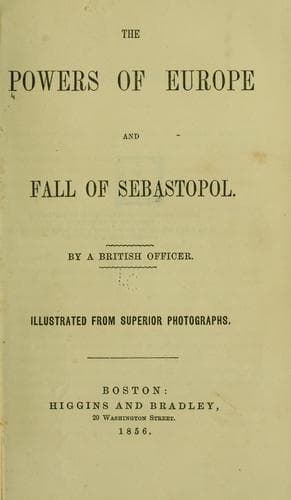
The Powers of Europe and Fall of SebastopolA British officer
History
The Powers of Europe and Fall of Sebastopol
A British officer
Crimean War, 1853-1856; Europe -- History -- 1789-1900
were, observed, “It is a great satisfaction to me that we have beaten
the French.” Once, when he spoke of his mother, he became agitated.
It was the only time. He inquired after his friends and officers who
had survived the battle, and did not even now forget to recommend
those whose merit entitled them to promotion. His strength failed
fast; and life was almost extinct, when he exclaimed, as if in that
dying hour the veil of the future had been lifted, and he had seen
the baseness of his posthumous calumniators, “I hope the people of
England will be satisfied; I hope my country will do me justice.”
In a few minutes afterwards he died, and his corpse, wrapped in a
military cloak, was interred by the officers of his staff, in the
citadel of Corunna. The guns of the enemy paid his funeral honors,
and the valiant Duke of Dalmatia, with a characteristic nobleness,
raised a monument to his memory. The following is so beautiful and
touching a description of his burial, that we cannot refrain from
quoting it, even though it may be familiar to most of our readers. It
was written by the Rev. Charles Wolfe, of Dublin.
“Not a drum was heard--not a funeral note--
As his corse to the ramparts we hurried;
Not a soldier discharged his farewell shot
O’er the grave where our hero was buried.
“We buried him darkly, at dead of night,
The sods with our bayonets turning,
By the struggling moonbeams’ misty light,
And the lantern dimly burning.
“No useless coffin enclosed his breast,
Nor in sheet nor in shroud we wound him;
But he lay like a warrior taking his rest,
With his martial cloak around him.
“Few and short were the prayers we said,
And we spoke not a word of sorrow;
But we steadfastly gazed on the face of the dead,
And bitterly thought of the morrow.
“We thought, as we hollowed his narrow bed,
And smoothed down his lonely pillow,
That the foe and the stranger would tread o’er his head,
And we far away on the billow.
“Lightly they’ll talk of the spirit that’s gone,
And o’er his cold ashes upbraid him;
But little he’ll reck, if they let him sleep on
In the grave where a Briton has laid him.
“But half of our heavy task was done,
When the clock struck the hour for retiring
And we heard the distant and random gun
Of the enemy, suddenly firing.
“Slowly and sadly we laid him down,
From the field of his fame, fresh and gory;
We carved not a line--we raised not a stone--
But we left him alone with his glory.”
Public-domain text, read in full here on John Shaqi.
Reviews
Reviews
No reviews yet
Be the first to share your thoughts on this work.
Elsewhere in the archive
Join the Discussion
Join the discussion
Sign in to leave a comment or review.
Sign InorCreate an account