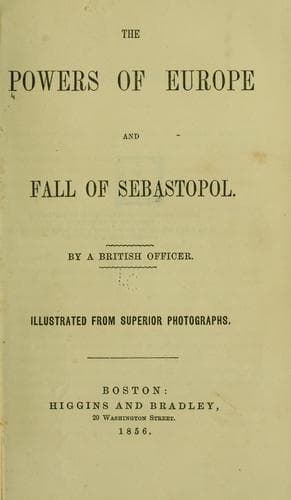
The Powers of Europe and Fall of SebastopolA British officer
History
The Powers of Europe and Fall of Sebastopol
A British officer
Crimean War, 1853-1856; Europe -- History -- 1789-1900
The English had by no means relinquished their designs upon the
Peninsula. The successes of Napoleon and his victorious army but
served to stimulate their hatred of the French, and spur them on
to further efforts. Another army was accordingly collected, and
placed under the command of Sir Arthur Wellesley, who landed in
Lisbon on the 22d of April, 1809. The force under his command was
fourteen thousand five hundred infantry, fifteen hundred cavalry, and
twenty-four pieces of artillery. The passage of the river Dwero was
his first contest with the French. In this he was successful, and his
success opened to him the gates of Oporto. Soon after occurred the
celebrated battle of Talavera. King Joseph was himself nominally
at the head of his troops; but Marshal Victor was, in reality, the
leader. Victor and Soult had both laid their plans before the king,
and urged them with all the eloquence they were capable of. So sure
was Victor of the victory, should his advice be followed, that
he said that, if his plans should fail, all military science was
useless. The event proved, however, that Soult was correct.
“The morning dawned beautifully clear, but a July sun poured down its
burning heat, until the soldiers were glad to seek shelter from its
rays in the quiet shade. Between the camps of the two armies flowed
a little murmuring rivulet, and, as the French and English met there
to slake their thirst, pleasant words passed between them. Familiar
conversation, the light laugh and the gay jest, were heard on every
side. But, about one o’clock, the deep rolling of drums along the
French lines announced to the allies that the hour had come when
those who had met to slake their thirst in those quiet waters were
soon to mingle to quell in blood their thirst for strife. They, too,
prepared for combat; and, when the loud booming of the guns gave the
signal that the battle was commenced, eighty cannon opened their
destructive fire, and the light troops went sweeping onward with the
rapidity of a thunder-cloud over the heavens, while the deep, dark
columns marched sternly after, and charged, with terrible strength,
the English lines. Then all along their fronts the deep-mouthed guns
opened their well-directed fire, and the infantry responded to the
furious attack with their rapid volleys, as they closed around the
head of the advancing columns, enveloping them in one sheet of flame,
that streamed like billows along their sides. It was too much for
human courage to endure; and, after bravely breasting the storm, they
were obliged to fall back in disorder.
Public-domain text, read in full here on John Shaqi.
Reviews
Reviews
No reviews yet
Be the first to share your thoughts on this work.
Elsewhere in the archive
Join the Discussion
Join the discussion
Sign in to leave a comment or review.
Sign InorCreate an account