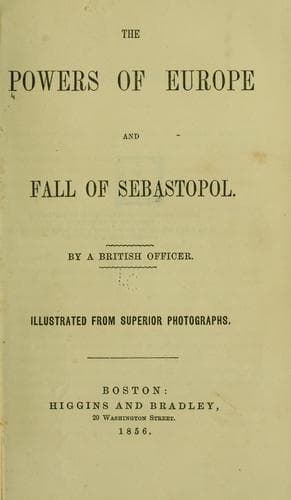
The Powers of Europe and Fall of SebastopolA British officer
History
The Powers of Europe and Fall of Sebastopol
A British officer
Crimean War, 1853-1856; Europe -- History -- 1789-1900
An instance of extraordinary heroism, in a youthful drummer, which
occurred during the assault, deserves to be recorded. His name was
Luciana Ancio, and he belonged to the artillery. He was stationed to
give the alarm, when a shell was thrown. A ball struck his leg off to
the knee, and felled him to the ground. Some women, who saw him fall,
hastened to remove him to a place of greater safety; but he refused,
saying, “No, no! my arms are left, and I can still beat the drum to
give my comrades warning in time to save themselves.” Heaven seemed
to smile upon his bravery; for he alone, of all those who suffered an
amputation of the thigh during the siege, recovered.
The Company of St. Barbara were everywhere to be seen, covered
with dust and blood, under the burning heat of a July sun. Those
courageous women, through an incessant fire of the batteries and the
musketry, carried water and wine to the soldiers, and bore back the
wounded. Every day produced acts of heroism equally conspicuous, for
the attack continued with unabated force. The sharp-shooters of the
enemy were stationed thickly in the trenches; and so fatal was their
aim, that for any of the garrison to be seen, only for a moment,
was certain death. And, although the sentinels were changed every
half-hour, nine were killed, in one day, at one post; and, after
this, it was only possible to observe what the enemy were about, by
some one in the force lifting up his head, and taking a momentary
glance.
Early in August, the besiegers had pushed their parallels to the
very edge of the fosse; but here their efforts were delayed, because
the nature of the soil obliged them to bring earth from some distance
to finish their works. About this time, Castellar de la Silva, at
the head of fifteen hundred men, attempted to throw supplies into
the city; but no precautions could escape the watchful eye of the
besiegers. The convoy was seized, and only five hundred men, of the
fifteen hundred who defended it, lived to tell the tale.
The main attacks of the besiegers were now directed against the
ravelin, which had become the chief defence of Monjuie. Attempts were
made, night after night, to storm it; but in vain. It was mined, but,
as the breastwork was wholly of earth, the explosion did no injury. A
battery was planted against it, and a sally was made by the besieged,
hoping to destroy it. This attack was headed by a priest. He was
fired upon, and fell. One of the French officers, at the risk of his
own life, protected him from further injury. But his humanity cost
him his life. One of the Spaniards, mistaking his object, cut him
down. The guns of the battery were spiked; but this brave attack was
of little use, for the French were well supplied with artillery, and
fresh guns were soon mounted, and played upon the gate and ravelin.
Public-domain text, read in full here on John Shaqi.
Reviews
Reviews
No reviews yet
Be the first to share your thoughts on this work.
Elsewhere in the archive
Join the Discussion
Join the discussion
Sign in to leave a comment or review.
Sign InorCreate an account