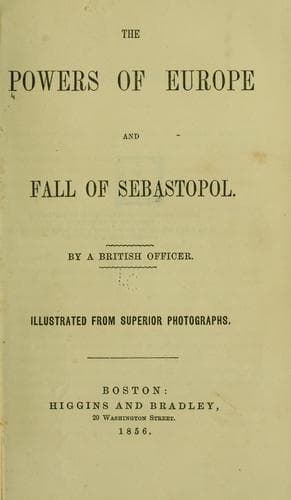
The Powers of Europe and Fall of SebastopolA British officer
History
The Powers of Europe and Fall of Sebastopol
A British officer
Crimean War, 1853-1856; Europe -- History -- 1789-1900
The city was closely invested by eighteen thousand French, under
the command of General Verdier, on the 6th of May, on the heights
of Casa Roca, where they erected a battery of eleven mortars, and
began to form their first line of circumvallation. The garrison was
too weak to make a sally, or otherwise prevent them. A flag of truce
was sent, with the conditions on which the French would leave the
city; but the only reply it drew forth was, that the Geronans would
hold no communication with the French, but at the cannon’s mouth. At
one o’clock on the morning of June 14th, the bombardment commenced.
As soon as the first shell struck, the loud tones of the _generale_
resounded through the streets, and every one flew to his post. The
female Company of St. Barbara, so far from shrinking from danger,
sought everywhere those spots where most was anticipated. What
bravery or daring could do was done; yet two castles were yielded
up, after a brave but vain resistance. Palamas was also carried
by assault. Very few of the garrison escaped, and those only by
throwing themselves into the sea. In July, three batteries kept up
an incessant fire upon three sides of the Monjuie. By one of these
discharges the angle on which the Spanish flag was planted was cut
off, and the flag prostrated into the ditch below. In an instant, a
man was lowered down from the walls to regain it. Balls fell like
hail around him; yet, apparently unmindful of the dangers to which he
was exposed, he calmly descended, and, having recovered the prostrate
banner, returned to his comrades unhurt, and again hoisted it on the
walls.
A breach was now made in the walls so wide that forty men might enter
abreast. The works progressed with more rapidity, as the fire of the
besieged had entirely ceased. It was not that Gerona was conquered,
but, finding that their ammunition was growing short, they prudently
reserved it until the nearer approach of the enemy should make it
more efficient. On the morning of the 8th, about three o’clock, the
French, under cover of a most tremendous bombardment, again assaulted
the city. Six thousand men marched up to the breach, and endeavored
to rush through; but, concealed there in the ruins of the ravelin,
lay a mortar, which discharged five hundred musket-balls every
shot. As they advanced, it was turned upon them, and their way was
soon impeded by the slain. Three times during that day the assault
was repeated, with the utmost resolution, by the assailants; and
three times were they obliged to retire before the heroic defenders
of Gerona, leaving sixteen hundred men lifeless on the field of
battle. But the effect of that dreadful attack was severely felt
by the besieged. The tower of St. Juan had been blown up, and only
twenty-three of its brave little garrison remained alive.
Public-domain text, read in full here on John Shaqi.
Reviews
Reviews
No reviews yet
Be the first to share your thoughts on this work.
Elsewhere in the archive
Join the Discussion
Join the discussion
Sign in to leave a comment or review.
Sign InorCreate an account