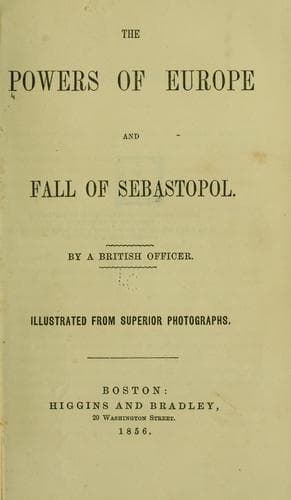
The Powers of Europe and Fall of SebastopolA British officer
History
The Powers of Europe and Fall of Sebastopol
A British officer
Crimean War, 1853-1856; Europe -- History -- 1789-1900
The allied army sailed from Cadiz on the 20th of February, for
Tarifa; but, a storm arising soon after they left, they were driven
past this port, and disembarked at Algesiras. They marched to Tarifa
on the 23d, under the command of General Thomas Graham. Here we
met; and, as we were more recently from home than these troops, we
had many questions to answer, and much information both to give and
receive. Before night, however, we had all our places assigned to us,
and were now ready for our march. But the Spanish General La Pena
had not yet arrived; and so we remained encamped here until the
27th, when he came up, with his forces; and to him General Graham,
for the sake of unanimity, ceded the chief command. All day we were
busy in preparations for our morrow’s march, expecting at its close
to come within a short distance of the enemy’s outposts. Early the
next morning, our whole army was in motion. We moved forward about
twelve miles, over the mountain ridges that descend from Ronda to
the sea; and then, having learned that the enemy were only four
leagues distance, we halted, for the purpose of reorganizing the
army. The command of the vanguard was given to Lardizabal, that
of the centre to the Prince of Anglona, while General Graham had
charge of the reserve, consisting of two Spanish regiments and the
British troops. The cavalry of both nations, formed in one body, was
commanded by Colonel Whittingham. The French army were encamped near
Chiclana, narrowly observing the movements of the allied armies, and
determined, at all events, to hold complete possession of the country.
The next day, March 2d, the vanguard of our army stormed Casa Viejas.
Having gained this small place, and stationed here a regiment, we
continued our march on the 3d and 4th.
Early in the morning of the 5th, as the advanced guards of our
cavalry had proceeded a short distance from the main army, they
suddenly came upon a squadron of French troops. Unfortunately for
them, several stone fences and enclosures prevented an immediate
attack, so that the French had time to form into a square, and
received their charge with great coolness and intrepidity. Their
square was unbroken, although numbers had fallen on both sides.
A second charge was equally unsuccessful, and the colonel of our
cavalry was mortally wounded. Our men then judged it most prudent to
fall back upon the main army, and no attempt was made to follow them
by the enemy. An anxious look-out was instituted, but the foe did not
again make his appearance, and at nine o’clock the same morning our
commander took up his position on the heights of Barossa.
Public-domain text, read in full here on John Shaqi.
Reviews
Reviews
No reviews yet
Be the first to share your thoughts on this work.
Elsewhere in the archive
Join the Discussion
Join the discussion
Sign in to leave a comment or review.
Sign InorCreate an account