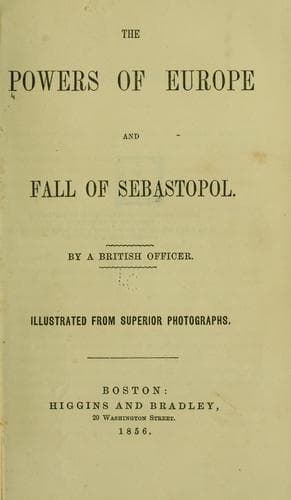
The Powers of Europe and Fall of SebastopolA British officer
History
The Powers of Europe and Fall of Sebastopol
A British officer
Crimean War, 1853-1856; Europe -- History -- 1789-1900
The hill of Barossa is a low ridge, creeping in from the coast about
a mile and a half, and overlooking a high broken plain. On one side
of this plain rise the huge coast cliffs, while the other is skirted
by the deep forest of Chiclana. Directly in front, there lies a
light pine wood, beyond which rises a long narrow height, called
the Bermeja. There were two ways by which this might be reached;
the first was through the woods, while the second was a narrow road
directly under the coast cliffs.
I have already alluded to the fact, that, although the English and
Spanish were fighting under the same banner, there was a great want
of unanimity of feeling and opinion as to the course which ought to
be pursued in ridding their country of their common foe. Nowhere,
in the history of the war, was this more apparent than at the
battle whose history I am about to relate. The deep-seated pride
of the Spanish made them unwilling to acknowledge or yield to the
superiority of the British, or hardly to allow that they were at
all indebted to them. A modern traveller tells us that, in a recent
history of this war, which was, not long since, published in Spain,
the British are not even mentioned, nor the fact of their assistance
at all alluded to. It was impossible for two nations so unlike in
their customs and manners, so different in language, religion,
and education, to be so closely associated together as they were
obliged to be, without occasions of dispute constantly occurring,
which would, probably, have terminated in open rupture, had not the
discipline of war prevented.
Public-domain text, read in full here on John Shaqi.
Reviews
Reviews
No reviews yet
Be the first to share your thoughts on this work.
Elsewhere in the archive
Join the Discussion
Join the discussion
Sign in to leave a comment or review.
Sign InorCreate an account