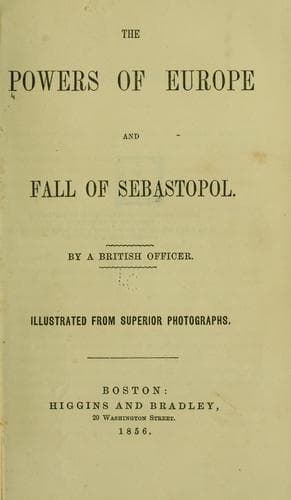
The Powers of Europe and Fall of SebastopolA British officer
History
The Powers of Europe and Fall of Sebastopol
A British officer
Crimean War, 1853-1856; Europe -- History -- 1789-1900
The fact that our gallant general had ceded the chief command to
the weak and imperious Spanish commander had occasioned no little
dissatisfaction among our men; while, from the conditions required
of him by Graham, we may judge that that general himself did not
pursue this course because he judged La Pena his superior in military
tactics. These conditions were, that his army should make short
marches; that they should be kept fresh for battle, and that they
should never approach the enemy except in concentrated masses.
Although the Spanish general had pledged his word of honor that these
conditions should be fulfilled, how much attention he paid to them
may be judged from the fact, that, on the day but one preceding this,
we had marched fifteen hours, through bad roads; and, after a short
rest, had occupied the whole night in our march to Barossa. Before
the troops had all arrived, or had any time for rest or refreshment,
La Pena commanded the vanguard to march against San Petri, which lay
about four miles distant. A detachment of the Spanish army, under
Zayas, had, only two days before, commenced an intrenchment at this
point; but had been surprised by the French, and driven back, so that
the enemy now held possession of all the outposts down to the sea.
But a short time had elapsed, after the departure of the vanguard,
when we were startled by the roar of the artillery, whose rapid
discharge, together with the quick volleys of musketry, showed us
that a sharp engagement had already taken place. Lardizabal,--far
more worthy of command than his superior,--notwithstanding the
unfavorable situation in which he found himself placed, succeeded in
forcing his way through the enemy’s troops, leaving three hundred men
dead on the field of battle, and in effecting a junction with Zayas.
Graham now endeavored to persuade La Pena to occupy the heights
of Barossa, as a superior position to the Bermeja. The Spanish
general not only refused to listen to his representations, but sent
an immediate order to General Graham to march through the wood to
Bermeja with all the British troops. This order he obeyed, although
it was in opposition to his own better judgment, leaving only two
detachments at Barossa, under Major Brown, to guard the baggage. He
would have left a stronger force, had he not supposed that La Pena
would remain in his present position, with his own troops, and would
thus assist those detachments, in case of an attack. But scarcely
had the British entered the wood, when La Pena, without the least
notice to his colleague, with his whole army, took the sea road under
the cliffs, and marched to San Petri, leaving Barossa crowded with
baggage, within sight of the enemy, and guarded only by four guns and
five battalions.
Public-domain text, read in full here on John Shaqi.
Reviews
Reviews
No reviews yet
Be the first to share your thoughts on this work.
Elsewhere in the archive
Join the Discussion
Join the discussion
Sign in to leave a comment or review.
Sign InorCreate an account