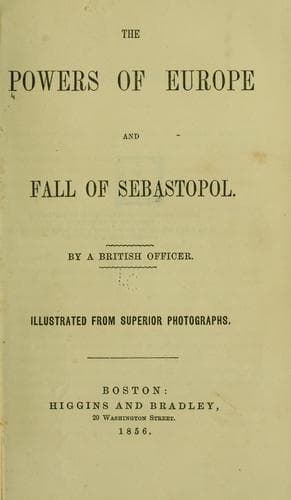
The Powers of Europe and Fall of SebastopolA British officer
History
The Powers of Europe and Fall of Sebastopol
A British officer
Crimean War, 1853-1856; Europe -- History -- 1789-1900
He demanded that his grenadiers
should march out of the breach. Permission was granted, but they
were obliged themselves to enlarge it, before they could do so. The
French immediately took possession of the city, and strengthened its
defences. Lord Wellington was much chagrined at the loss of this
place, and early in May sent Lord William Stewart to invest it. The
siege was carried on with vigor, but under great disadvantages,
arising from want of the proper materials for construction of the
works. In endeavoring to erect their batteries, the engineers were
obliged to labor exposed to a heavy fire from the city, which proved
so destructive, that, before one small battery against one of the
outworks of the town was completed, seven hundred men and five
officers had fallen. When, at length, on the morning of the 11th
of May, this battery was completed, before night five of its guns
were silenced by the enemy, and the rest were so exposed that it was
impossible to man them. The same day news reached our army that the
French army were coming to the relief of Badajos. Immediately our
commander took steps to raise the siege, as to remain there would
have exposed our whole force to destruction. On the night of the
13th, he removed all his artillery and platforms; and on that of the
14th, his guns and stores. But so secretly was this done, that the
French were entirely ignorant of it, until, as the rear guard were
about being drawn off, they made a sally, and, of course, discovered
it. Soon after this, the battle of Albuera occurred.
Public-domain text, read in full here on John Shaqi.
Reviews
Reviews
No reviews yet
Be the first to share your thoughts on this work.
Elsewhere in the archive
Join the Discussion
Join the discussion
Sign in to leave a comment or review.
Sign InorCreate an account