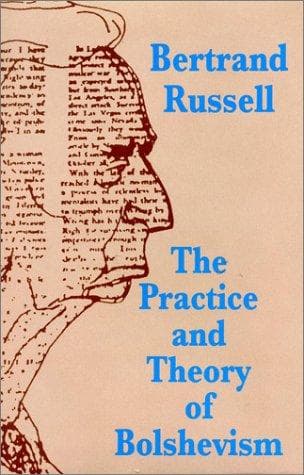
The Practice and Theory of BolshevismRussell, Bertrand
Religion
The Practice and Theory of Bolshevism
Russell, Bertrand
Communism -- Soviet Union -- History; Soviet Union -- Social conditions
I asked him next whether he thought it possible to establish Communism
firmly and fully in a country containing such a large majority of
peasants. He admitted that it was difficult, and laughed over the
exchange the peasant is compelled to make, of food for paper; the
worthlessness of Russian paper struck him as comic. But he said--what
is no doubt true--that things will right themselves when there are
goods to offer to the peasant. For this he looks partly to
electrification in industry, which, he says, is a technical necessity
in Russia, but will take ten years to complete.[2] He spoke with
enthusiasm, as they all do, of the great scheme for generating
electrical power by means of peat. Of course he looks to the raising
of the blockade as the only radical cure; but he was not very hopeful
of this being achieved thoroughly or permanently except through
revolutions in other countries. Peace between Bolshevik Russia and
capitalist countries, he said, must always be insecure; the Entente
might be led by weariness and mutual dissensions to conclude peace,
but he felt convinced that the peace would be of brief duration. I
found in him, as in almost all leading Communists, much less eagerness
than existed in our delegation for peace and the raising of the
blockade. He believes that nothing of real value can be achieved
except through world revolution and the abolition of capitalism; I
felt that he regarded the resumption of trade with capitalist
countries as a mere palliative of doubtful value.
He described the division between rich and poor peasants, and the
Government propaganda among the latter against the former, leading to
acts of violence which he seemed to find amusing. He spoke as though
the dictatorship over the peasant would have to continue a long time,
because of the peasant's desire for free trade. He said he knew from
statistics (what I can well believe) that the peasants have had more
to eat these last two years than they ever had before, "and yet they
are against us," he added a little wistfully. I asked him what to
reply to critics who say that in the country he has merely created
peasant proprietorship, not Communism; he replied that that is not
quite the truth, but he did not say what the truth is.[3]
Public-domain text, read in full here on John Shaqi.
Reviews
Reviews
No reviews yet
Be the first to share your thoughts on this work.
Join the Discussion
Join the discussion
Sign in to leave a comment or review.
Sign InorCreate an account